Pages

Showing posts with label math facts. Show all posts
Saturday, October 17, 2015

Math Facts Fluency: May the Force Be With You!

Math facts fluency....AH... how I love thee! Yes, that is correct! I love teaching my kids their basic math facts! What? Am I a bit crazy? Maybe.

Math facts fluency is one of the most dreaded things to teach for many teachers. I, however, love it in my classroom! But most importantly, my kids LOVE it! They look forward to their math facts test each week. They "remind" me every Thursday that it is math fact test time! If we run out of time on Thursday, there is a TON of moaning and groaning. I make it a point to not skip math facts tests!

The class goal is for each student to pass their leveled math test each week. They need to complete 50 problems in 3 minutes. This is a suggested time, but works best for most of my students. You can also 15 and 25 question pages if that best suits your students' needs. 


We keep a class chart to show progress towards mastery. Each time a student passes a test, they get a sticker next to their name. 


I also use individual student charts and keep them in a binder to track student progress. These are great for student conferences. It is a clear visual to show how many weeks a student is on each level or how quickly they are moving through the levels.


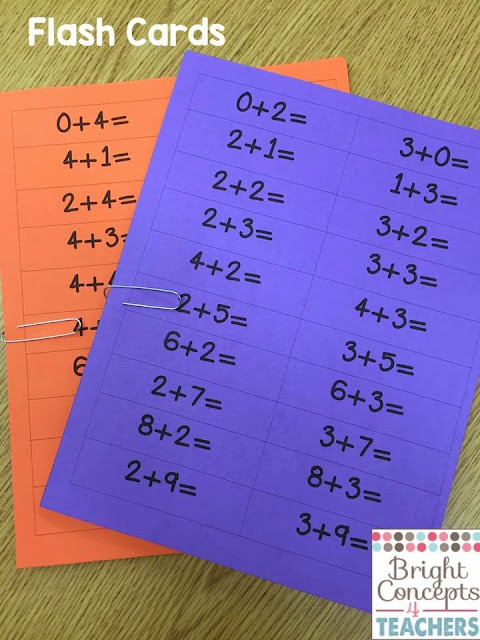
To help with organization of the leveled tests, I pre-copy a class set of each level of the 50 question math tests so they are at my finger tips ready to go each week. I also have color coded sheet of flash cards for my kiddos copied. After they pass a level, I give them a new set of cards to cut out and put on a ring to keep at their desk to study throughout the week. 


After the students take their tests and they have been corrected, they go home with one of these awards. If they pass their test, they get a slip that congratulates them and tells them which level to study for the following week. If they don't pass, they get a slip encouraging them to continue practicing for the same test next week. 


My students love the Star Wars theme! They can't wait to become Math Facts Jedi Knights!

Are you ready to get your students on the road to mastering their math facts? Click the picture above to grab your set of addition and subtraction progress charts for FREE! Make sure to head on over to Bright Concepts 4 Teachers for more fun math ideas too.


Monday, April 13, 2015

3 TIPS for Kinder Math Success


Hi EVERYONE!  It’s Kimberly from Loving Kinders!  I am very grateful to be posting as a guest author today at Who’s Who and New.   I LOVE THIS blog.  It gives us so many amazing tips and tricks.  So, today I wanted to share with you my tips when teaching math!

#1 Engage THE Learner
I find Interactive Notebooks are a great way to ENGAGE my students.  Actually, they are a HUGE hit in my class. 
This is why:
I put the students in charge. -They LOVE THIS! I use a document camera and allow one student to be the “teacher model” and they assemble the page for the class. We note ALL of the steps on the board and the students take off on their page.
Now Be AWARE!
I will tell you that Interactive Notebooks in kindergarten are NOT easy so don’t get involved if you don’t want to take TIME to TEACH each child how to assemble the pages and to show them your OWN expectations. For instance, we cut triangles on each page for bookmarks, we ONLY use glue sticks, and we NEVER rush with our work.
My students are experts now!
Now, every TUESDAY we have our interactive notebook time and my kinders are
ENGAGED and PROUD!


#2 EVERYONE needs to respond
I am sure that you agree, when teaching any subject area if you only call on one person for an answer then only ONE person is engaged. That is why I always use
TURN AND TALK
OR
-my new FAV-
LEAN AND TELL
with everything MATH lesson.  The key is now how to use it.  TURN and TALK is ONLY for longer answers where there needs to be discussion.  LEAN and TELL is a one-word only answer.  My kids love using both during our lessons.  Today I taught time and we made clocks.  The kinders walked around the room turning and talking with neighbors for about 12 minutes.  I stood back and watched the magic happen.
#True teacher moment

#3 Memorization
With so many teaching styles and the ever-changing student population, sometimes we fail to remember that memorization is a skill that needs to be developed, especially with math facts.  I have a daughter with dyslexia and when she was learning her math facts it was very important for her to have her math facts memorized.
This only assisted her math development.  I use math fact rings.  I make them for the students and they take them home for on-going practice.  I often have “bag checks” and review facts with my kinders. This helps with fact fluency.


I hope you were able to take some ideas with you and I thank you for reading and teaching!

Until Next time... 


Here are the products I used.


Monday, March 23, 2015

Mastering Math Facts

Hi there!  It's Anita from Primary "Teach"spiration, and I'm here to give some tips on helping all of your students to master their math facts.

Getting EVERY student in your class to master math facts can sometimes be a challenge!  We all know it's much easier for some than others, so we must have a plan to help every student become successful.  This can be accomplished by allowing your students to learn the facts at their own pace - Ah-ha, differentiation!  Realizing this years ago, I came up with this simple methodical format for making every individual in my class successful at memorizing addition (and subtraction) facts.  And it never failed me; in fact, it worked beautifully!  Most of you probably already do something similar, but I'm in a mood to share. So here it goes!

I've always taught at a second grade level, so my plan centers around second grade, but can easily be adapted to other grades.  At my school, there are four nine-week quarters.  So, my schedule for teaching mastery of addition and subtraction facts was divided between those four quarters as such:

1st Quarter  - Addition facts within 10
2nd Quarter -Subtraction facts within 10
3rd Quarter - Addition facts within 20
4th Quarter - Subtraction facts within 20.

I begin 1st Quarter with every student practicing in a variety of ways:

Flashcards
                                                                          
We use the flashcards to practice in different ways.  Sometimes we divide up into two teams and
play Math Baseball as shown below. Other times, we play Around the World.  Yet, other times, I pair up students to use the flashcards to quiz one another. Whichever way we practice, they love it!

                                                                                Games


One of the games the kids love to play is Math Baseball.  In this game, the class is divided into two teams.  Each team huddles together to choose a team name; then I write the team names near the top of the white board.  I stand at the front of the room with the flashcards, while the two teams line up in separate lines facing me.  We flip a coin to determine which team is "up to bat" first.  I stand in front of the first person in line of the "batting" team and lift the first flashcard.  He has 5 seconds to give the correct answer.  If he does, it is considered a hit and  he moves to first base (I have the bases posted around the room).  If he misses, it is considered a strike and he moves to the back of his line. When a students makes it around all bases to Home Plate, he puts a tally mark on the white board under the team name.   After three outs, the next team "bats" and play continues.  The kids love it when I act as the announcer with things like, "Jones is up to bat with two men on base!"  For time's sake, I often make shortcuts, such as only two outs or I leave out third base.  It all depends on the time allowed.

                                                                                 Centers
         

One of my math centers is the math facts station.  I switch it up with the group of facts that the majority of the class is working on.  The center activity varies from task cards to game boards, and more.

                                                              Pencil & Paper 


There are varying opinions about whether ordinary pencil and paper worksheets are a good thing or not.  In my personal experience, I have found that if students are required to complete just one math facts worksheet every day, consistently, the odds of them truly learning the facts are increased exponentially!  This does not negate the importance of also practicing in other fun ways.  In fact, the combination is key to mastering the facts.

I also include practice as a brief part of homework in whatever way the child and parent choose.


For the first week of addition fact practice at school, we begin with +0,+1.


Every day students will practice in the various ways, and then take a daily "mad minute" quiz to assess mastery.
I cut this sheet into four strips (20 problems).  Students are timed to complete a strip in one minute.

Those who pass the quiz 100% will also take a timed final assessment.  I require 75% to confirm mastery before they move to the next set of facts.


Once mastery is confirmed, they will continue to practice +0,+1 for the week, but will also move on to practicing +2 facts.

Those who don't pass right off will have the opportunity to do so by quizzing each day until mastery is achieved.  It usually only takes that first week for most everyone to master +0,+1, so I usually only give about a week before moving on to the first +2 quizzes (given at the same time as any +0,+1 quizzes if needed).  We practice +2 (along with +0,+1 review) for that second week, and usually another week before most everyone has mastered +2 (+2's are much harder).

Then we move on to +3 in the same way, and so on with a goal of everyone passing all levels by the end of the first quarter.  At that time, I give a cumulative timed final assessment of all the facts covered first quarter.

2nd Quarter I follow the same format with subtraction facts within 10: 1st week -0, -1,  2nd week -2, etc.  Third and fourth quarters follow suit.


Thanks for stopping by!  I hope you've enjoyed reading about how I was able to help my students be successful at mastering their math facts.  And I hope it will be helpful to you!

You can download a free copy of my directions to the Math Baseball game by clicking on the image.


If you're interested in my Math Facts Mega-Bundle, CLICK HERE.  Or you can find the individual packs and bundles at my STORE.  And please feel free to visit my BLOG any time!


Tuesday, March 17, 2015

Are You Game? Mastering Multiplication Facts with Games!

Hi Everyone,
It’s Teresa here from
Fun Games 4 Learning. As you can guess from my blog name and also my
TpT store, I am all about games.

I love using games in the classroom especially for math!


It is wonderful to see kids so enthusiastic about a game that they don’t even realize that they are learning and applying math skills

Today I would like to share some of my
favorite games that I use for reinforcing multiplication facts.

As children play it is amazing how quickly they develop an instant recall of their basic facts. My favorite games are those that are quick and easy to prepare and quick and easy to play. The first one I have to share with you is a game that I call Find It First.

FIND IT FIRST
Find It First is a simple game that can be used to practice many different skills. It is a quick game for 2 players. Once the first round is over, 2 new players can take their place.


On
the board or a piece of card write the answers to the facts that are to be studied. For example, to study multiplication facts for 7 write the answers randomly over the board or card. I then add a few random numbers also. I like to use a small whiteboard.

Make sure the numbers are where the children can reach them with a pointer or a ruler. The two players then stand either side of the numbers. The caller or the teacher calls a number fact, e.g. 4x7. The first player to find the answer and point to it scores a point. When we play it in the classroom, the first player to score 3 points is the winner. After that we choose two new players.

The kids really love this fast paced game.
 
Another favorite for basic facts is a simple domino game.

DOMINO KEEPERS MULTIPLICATION
This is a game for 2 players. All of the dominoes are placed face down in the centre. Both players pick up a domino at the same time. Each player multiplies the numbers on their domino and the player with the highest answer keeps both dominoes. If both players have the same answer, each keeps a domino. The winner is the player with the most dominoes when all dominoes have been used.


This game ticks all of the boxes - the kids love it, it is simple to play and all you need is a set of dominoes!

I also have many printable games that can be used for multiplication facts.

NO PREP MULTIPLCATION GAMES 
These no prep games are really popular with the kids and also the teachers. Many teachers use them for homework and have the parents play the games with their children. All the kids need are pencils and some games require dice.

The games are ideal as a math center or as an activity for fast finishers.

There are some freebie games for you to try at http://www.teacherspayteachers.com/Product/Multiplication-1199527 . 


There is a larger collection of 26 no prep multiplication games available at http://www.teacherspayteachers.com/Product/Multiplication-Games-1197085


You will find that the games are differentiated so that you can have some children working on times 2 facts while others are challenged by harder facts.
In these games the 2 players compete to either make the longest line or to make four in a row. There are also games where players have to find a line of 3 numbers that can create a multiplication family, e.g. 9, 4 and 36. I love the challenge of this game as it really does make the kids think and apply their facts.


Well Happy Multiplying! I hope you and the kids enjoy these games!

Till next time!
Teresa