Pages

Showing posts with label Reading. Show all posts
Sunday, October 22, 2017

Teaching The Author's Point Using Video Games (Plus a Giveaway)


As a literacy coach teaching persuasive reading and writing to elementary age students, I recently tried to find a topic that my students connected with and had an author’s point of view in which they might disagree.  Because let’s be honest, the ones on recycling and water are just…old.  I wanted fresh material.   

And any time teachers need fresh material, what do they do?  We steal, borrow, and take good ideas from real-life experiences - and sometimes our friends and colleagues. Well, I happened to have the real-life experience of strongly disagreeing with my teenager step-son on one particular point. (Most of us probably do with our teens)

You see, three years ago, I got a step-son who lives for fast internet and all-night playing of video games.  Since knowing Drew, I have slid in comments here and there about the negative effects of video games.  I assumed my comments would trigger his hormonal, irrational mind into thinking - Wow.  She is so smart.

This didn't happen.

But from conversations with Drew, I did realize that video games was a wonderful topic to engage my students.  And because I wanted to connect and relate to them, I decided to write a "letter" asking the principal to allow video games in school.  (You can find the letter here.)  I know!  You all thought I was going to go against it.  So did my students.


 At first, as I sat down to write my letter request and the reasons they should be in school, I literally thought “Nothing.  Nothing good comes from video games.”  

But I knew this wasn’t true.  Nor was that making an interesting letter.
So I fought to see it from Drew's perspective, and I was shocked with what I learned.  I not only discovered that kids could learn "soft skills" valued in the workplace, but I discovered how I could be a better parent to Drew and be a better teacher.

By putting myself in Drew’s (and my students’) shoes to make the point that video games should be allowed in school, I was pausing to consider what is important to them.  I looked for the things that they love about gaming that would also be considered a benefit to an adult.  

What I Learned
  1. Video games challenge their brains. There is a lot of action going on in those games.  Gamers must think through decisions and problem solve.  They are trying to create, build, and conquer.  This takes problem-solving skills.  There are also other players moving in real time.  As the players are playing, they are being challenged to work as a team.
  2. Video games engage children. Therefore, it cuts down on misbehavior in classrooms (and in homes).  Children & teens want to be engaged!  They want their brains to be focused and challenged.  When they are, they don’t think about snacks, water breaks, or how many students they can make laugh. Ever notice how in the middle of talking, a student will ask to go to the bathroom.  But the minute you hit play on a video, they no longer have to go?  Same thing.  Video games are engaging them because they’re focused on winning. 
  3. Video games teach perseverance. They play.  They lose.  They play again.  The cycle continues as they get better and better and work towards winning.  It’s something we appreciate in athletes and mathletes.  We should appreciate it in gamers too.  This is literally the whole growth-mindset & grit theory that is trending now.  Students feel they are defeated for a millisecond when they lose, and then it’s back to another game to try again. 
How do these things make me a better teacher and/or parent?

The short answer is I realized the value of putting myself in my teen's shoes for a moment.  How often do we all need to pause in our own crusade and consider the perspective of the opposing argument?  This skill alone is something I want to teach all children to make a better world.

Specifically as a teacher, I reflected on the three things video games offer that captivate my students.  They want to be challenged.  They want to be engaged.  They want to persevere, get better, and win.
It’s my job as an educator to help facilitate these three things each day in the classroom. My instructional practices should include these things as much as possible.  Don't I want to be challenged, engaged, and grow myself?  I want to offer that to my students.

Misbehaving students aren’t always a result of my instruction, but when I have misbehaving students, I must stop and reflect.  Are the students engaged?  Are they feeling challenged, but not defeated?  Are they learning to persevere so they can win?

As a teacher and parent, I need to stop and reflect.  It’s so easy to think our kids are acting crazy/disrespectful/fill-in-the-blank and not see the situation from their perspective.

In the end, I wrote a letter "from Drew" with an author's point, reasons, and evidence that would convince a principal to allow video games.  (You can find the differentiated passages here.)  My students loved it so much, I then wrote one "from Mara" (my step-daughter), asking the principal not to allow video games in school!  These can be found here.

I truly believe RI 8 (Author's Point, Reasons, & Evidence) and W1 (Opinion writing) are two of the most important standards we can teach.  Persuasive skills, considering other people's point-of-view, and debating are skills they will use in almost every relationship, job, and stage in life.  We need to make sure we are equipping them for these life skills, and not just checking a box.

Teaching this standard made me a better teacher, and I hope it grows you as it grew me.

It also made me a better bonus mom. Truthfully, I may not ever fully get on "Team Video Games".  But I always want Drew to know I am on "Team Drew".

P.S. 
You can find my Author’s Point, Finding Logical Connections, and Differentiated Reading Passages & Activities “Video Games In School” at my TPT page.  The "No Video Games" will be FREE for the first week this is posted as a gift to the readers!


Follow me on TPT (Mrs. Wilson Wonders), Twitter @NatalieWilson43, Instagram @NatalieWilson2012, or at my own blog – Freshly Designed. 


Saturday, April 22, 2017

End of Year Emoji Day


As the end of the school year approaches, I am always looking for ways to keep my students engaged and learning right until the last day.  This year I decided to create some activities featuring emojis to do just that.  I was inspired by the idea after Scholastic sent me some emoji themed bookmarks with my last book order.  The students loved them and were so excited because they contained those little smiley faces.  So I decided to host an "Emoji Day" to hopefully capture some of their excitement and help with the countdown to summer break.  Who knows, I may even stretch it out over two days!

To build some excitement about the upcoming emoji day, you can ask your students to dress all in yellow and black.  Then decorate your class door to greet them as they arrive in the morning.  During morning meeting show them some of the activities they will be completing during the day.  I also bought some emoji themed props to help set the stage for the day.  I found a kissing emoji at my local dollar store and I was lucky to grab these emoji themed buckets in the 50% off section of Walmart.  They will be great for holding the materials for each center.

I find this time of year it is important to change things up and try adding something different from the usual routine.  I am going to have students collect different emoji collector cards as they finish each activity.  This will work great as a motivator for students to finish their work.  These collector cards can then be kept in the student's wallet to take home at the end of the day.  I may add string to each wallet and students would be able to wear them as a necklace during the day.  I think it is important to let students be creative.  Give them a blank t-shirt or iPhone sheet and let them create what they thing the next emoji should be.


I think it is important to also keep practising math, reading and writing skills right up to the end of the school year.  My students slide back over the summer and I want to make sure I am doing my best to slow down this process.  Having students roll an emoji dice to practise graphing skills and reading all about emojis is a great way to keep students learning.  Did you know that there are 69 new emojis coming soon?  Did you know that there will be a curling stone, T-REX, and gloves?  I had no idea before doing a bit of research.  I also want my students writing everyday and adding some emojis just seems to make reluctant writers want to pick up their pencil and get started.

Finally, this time of year is all about making memories.  Students can make an emoji booklet which highlights some of their favorite things on one side and then collecting the autographs of their classmates on the other side.  What a great keepsake to look back on in the future.  If hosting an "Emoji Day" sounds like something you would like to try, you can find these activities here


Saturday, November 7, 2015

Teaching Authors Purpose with Scholastic Order Forms

Hey Ya'll! It's Marcy from Saddle Up For 2nd Grade

Saddle Up for 2nd Grade

Classroom teachers always have old Scholastic reader order forms lying around. They either send way to many or you have stacks that just don't ever get sent out. Why not put them to good use?!? They are perfect for teaching and reviewing authors purpose.

Teaching Authors Purpose with Scholastic Order Forms by Saddle Up For 2nd Grade

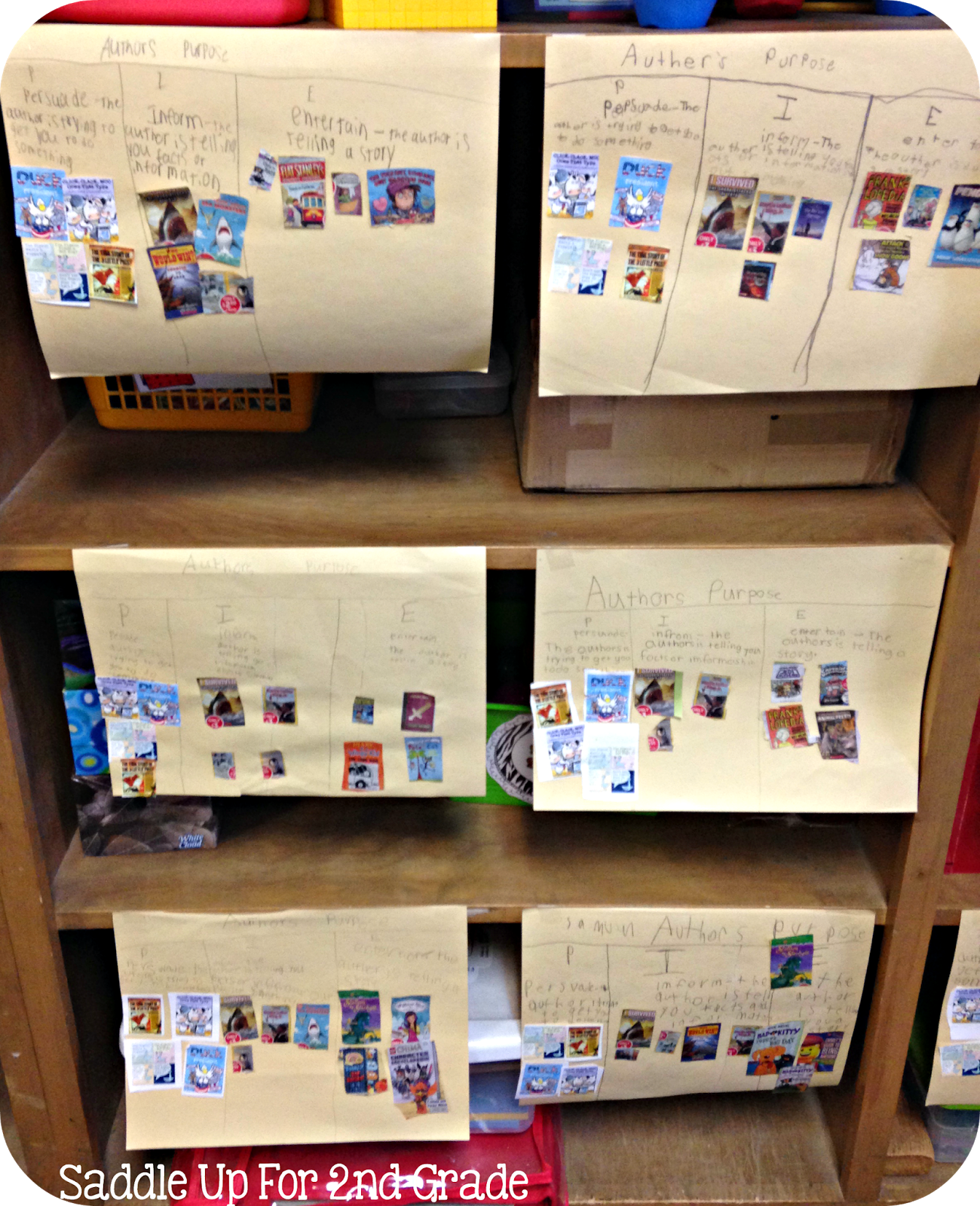
After reviewing the three types of stories, I busted out some old scholastic reading order forms. They created a graphic organizer with drawing paper then they had to find 4 examples of each type and sort them onto their paper. 

Teaching Authors Purpose with Scholastic Order Forms by Saddle Up For 2nd Grade

They did really well with each type except for persuade. This was tricky for them because a lot of the stories in the order form they haven't heard before and I hadn't either. So we brainstormed a list of books that we have read as a class that fall under that category. While they were searching for inform and entertain, I printed off the covers of some of the books we came up with as a class. All of their "P" books are the same but everything else they did on their own. 

Teaching Authors Purpose with Scholastic Order Forms by Saddle Up For 2nd Grade

Teaching Authors Purpose with Scholastic Order Forms by Saddle Up For 2nd Grade

Teaching Authors Purpose with Scholastic Order Forms by Saddle Up For 2nd Grade

This activity was quick, easy, and required NO PREP! Even my lower learners were able to do this without much guidance. It is visual, hands on, and ENGAGING! 

Teaching Authors Purpose with Scholastic Order Forms by Saddle Up For 2nd Grade

So next time you get extra Scholastic order forms, don't throw them away! 


Tuesday, October 27, 2015

Ten Alternative Book Projects to Engage Your Readers

Hey!  It's Nicole from Learning Lab again. I'm going to blog about turing your boring book reports into fun, alternative book projects!  

Last year was my first year teaching Read180 in a few years.  I love Read180 and what I have seen it do for my kiddos so I was excited to get a chance to implement it again.  But...the book projects included with the program are B-O-R-I-N-G!  Sure, some of them are pretty good, but the directions can be questionable and I find myself using the same two projects over and over with my class.  

My students started to get frustrated (beyond frustrated) with the repetition so I promised them that one of my summer tasks would be to create new book projects, just for them.  

I mean, who doesn't just LOVE working on school stuff during summer break?  You know we all do it!

These book project ideas are a break from the traditional book report and can be used with any book!  So far, they are loving the new book projects!  I see a lot more effort being put into their work.  

Here are some ideas:


This one is pretty self-explanatory.  The students can write a letter to the author.  Depending on whether the author is alive or not, you students could actually mail their letter out!  Wouldn't it be wonderful if they got a reply?!?


All kids watch a lot of movies.  They're exposed to movie posters every time they set foot in a mall or theater.  The creativity you will see when they create a movie poster for the book they just read can be amazing!


What kid doesn't love Diary of a Wimpy Kid or any other graphic novel?  They're going to love creating their own comic strip using details from the book they just read even more!
  
This is their chance to be honest about the book they just read.  They can even give it a 5-star rating if they totally loved it!


Timelines help kids practice sequencing and retelling.  Timelines also have less writing and are more visual which is perfect for some of your kiddos!


Your artistic kids will love redesigning the book cover.  The catch is that they also have to rewrite the short summary on the back of the book too!


Here is another visual project that will pull some of your readers right in!  Imagine being able to see all of the places from your book on a map!   


Every book has a juicy part fit for the front page of a newspaper.  Here is a chance for your kids to write an article retelling a specific event.  


Your kids will get a kick out of "interviewing" their favorite character.  First, they will need to come up with some questions and then they'll need to answer them from the character's point of view.


I find that when you add technology to just about anything, kids will gravitate towards it.  I am sure they will love putting together a PowerPoint presentation all about the book they just read.

What other book projects do you like to use with your students?  I would love to hear your ideas!

If you want to try alternative book projects in your classroom, I have expanded on these ideas and created directions sheets for each project for my students.  


Each project includes the task and the plan with detailed directions including "must haves" and "may haves".  There is also a Do Not Forget section that give little reminders to keep your kids on track. 

I have also included two versions of a log to keep track of which projects your students have completed.  The first one gives them choice and they just log their choice.  The second one lists each project and the student has to complete each project once before repeating a choice.  

Do you use interactive notebooks in your classroom?  No worries!  I have reduced the size of each page so that it fits right into an interactive notebook!

Thanks for stopping by!  If you want to read more about how I use interactive notebooks with Read180 and pick up a freebie, you should check out this blog post.  

I would love to see you again soon.  You can find me on my blog, in my TpT store (Learning Lab), or on Instagram (@Learning_Lab).  Instagram is my favorite way to connect with teachers.  


Wednesday, October 21, 2015

Differentiated Sight Word Practice & Freebie

Hi there! Today I am here from K's Classroom Kreations to let you all in on how I use differentiated sight word lists in my first grade classroom. First of all, let me emphasize the importance of learning sight words, or our "see it and say it" words. I teach my students that they need to save their brain power for decoding challenging words. Sight words are often tricky to sound out and are used so frequently that as readers we are more efficient if we just recognize them instantly. 


I start by assessing all of my students on the 220 Dolch Sight Words. Although my county suggests that we start on List 1, I always start with Pre-Primer and Primer words because many of my firsties come in not having mastered these Kindergarten words. My goal is to see where each child is at to help best meet their needs. I do not want to skip over Kindergarten words for those who need them. At the same time, there is no reason to be giving one of my higher readers basic sight words when they need to be challenged like everyone else. 

Once I have a baseline, I create Sight Word Rings for each student. I simply hole punch the corner of index cards and use a key ring to attach them together. 


I print a label for the front of each set that encourages parents to practice words daily with their children (in line at the grocery store, in the car, before bed, etc.). For your own FREE copy of the labels (to be printed on Avery 2 inch X 4 inch labels, model  #5163 or plain paper) click the image below. Please note, when printing with Avery Labels, the PDF is formatted at the correct size so you may need to click "Print Actual Size" rather than fit to page, etc.
I then select the first 10 words that the child was unable to read instantly (within 3 seconds) and record one per side of the index cards. For students who are really struggling I do not suggest more than 5 words per week. 


The 10 words this child would have on their ring are " down, said, where, new, now, out, saw, that, there, they"


In addition to practicing these words during word work time, students take the word ring home each week and bring it back on Friday for assessment. We also practice grade level sight words daily during our morning routine. However, these individualized word ring lists seem to really help the most. Once students master both sides of the index card (I test with the cards out of order for true mastery) I take the card off and then replace it with a new card and the next unknown words on their list. 


Each month I highlight the words they have mastered in a new color on their overall tracking sheet. As you can see, children are able to work at their own level. It does take a decent amount of time to test each child but I usually try to schedule time with a parent volunteer or assistant for this purpose. Once they get the hang of the routine this is a simple yet meaningful task for them. 

Once a student masters all of their Dolch Sight Words (I have 4 first graders already this year!) I begin them on Fry's Top 1000. I start with list one and repeat the same process as before, just adding new lists as needed. I print multiple copies of the pages from this source here and keep them in a folder, all ready to go. 


Well, thats it! I hope you were able to see how easy it is to differentiate your sight word lists to make it a truly meaningful experience for each of your students. For more ideas be sure to check me out on my blog, K's Classroom Kreations


To save this idea for later, Pin here:


Wednesday, July 29, 2015

Lexile, Guided Reading, & Topics Oh My!


Lexile, Guided Reading, and Topics Oh My!

Over the last year I have been so overwhelmed with organizing my classroom library.  It seems every month teachers were changing how they organized.  Going from guided reading levels, topics, and genres.   Last year I kept mine organized by topics: friendship, animals, winter, and holiday books.  It worked great for me, but my students had a hard time picking books for buddy reading during our daily 5 centers.  I taught them how to find the perfect book and we made anchor charts, but still the Charlie the Ranch Dog books were too good to pass up!  I can’t blame them, the amount of freedom was too much and temptation gave in.  I decided to dedicate a week to leveling all my books and placing them in guided reading level baskets. 

Here are some easy steps!

1.  Take all your books out and make a huge pile.  This will for sure bring your anxiety level up a notch!
2.   Download the app Literacy Leveler!  For the most part it had the majority of the books available for leveling.  The ones I was unable to find I used Scholastic Book Wizard!
3.  Start scanning!
4.  Mark with level!  I used garage sale dots on the back of each book and wrote the level.
5.  Place in baskets J  I went to the Dollar Tree and bought 25 of their large blue bins.  It took me three trips to three different stores to accumulate the 25, but well worth the savings!  I have heard you can order online however I do not think you can specify the color. 
6.  Enjoy your hard work before 30 little friends start book shopping!

Here are some pictures of the process.