Pages

Showing posts with label 2nd Grade. Show all posts
Sunday, October 22, 2017

Teaching The Author's Point Using Video Games (Plus a Giveaway)


As a literacy coach teaching persuasive reading and writing to elementary age students, I recently tried to find a topic that my students connected with and had an author’s point of view in which they might disagree.  Because let’s be honest, the ones on recycling and water are just…old.  I wanted fresh material.   

And any time teachers need fresh material, what do they do?  We steal, borrow, and take good ideas from real-life experiences - and sometimes our friends and colleagues. Well, I happened to have the real-life experience of strongly disagreeing with my teenager step-son on one particular point. (Most of us probably do with our teens)

You see, three years ago, I got a step-son who lives for fast internet and all-night playing of video games.  Since knowing Drew, I have slid in comments here and there about the negative effects of video games.  I assumed my comments would trigger his hormonal, irrational mind into thinking - Wow.  She is so smart.

This didn't happen.

But from conversations with Drew, I did realize that video games was a wonderful topic to engage my students.  And because I wanted to connect and relate to them, I decided to write a "letter" asking the principal to allow video games in school.  (You can find the letter here.)  I know!  You all thought I was going to go against it.  So did my students.


 At first, as I sat down to write my letter request and the reasons they should be in school, I literally thought “Nothing.  Nothing good comes from video games.”  

But I knew this wasn’t true.  Nor was that making an interesting letter.
So I fought to see it from Drew's perspective, and I was shocked with what I learned.  I not only discovered that kids could learn "soft skills" valued in the workplace, but I discovered how I could be a better parent to Drew and be a better teacher.

By putting myself in Drew’s (and my students’) shoes to make the point that video games should be allowed in school, I was pausing to consider what is important to them.  I looked for the things that they love about gaming that would also be considered a benefit to an adult.  

What I Learned
  1. Video games challenge their brains. There is a lot of action going on in those games.  Gamers must think through decisions and problem solve.  They are trying to create, build, and conquer.  This takes problem-solving skills.  There are also other players moving in real time.  As the players are playing, they are being challenged to work as a team.
  2. Video games engage children. Therefore, it cuts down on misbehavior in classrooms (and in homes).  Children & teens want to be engaged!  They want their brains to be focused and challenged.  When they are, they don’t think about snacks, water breaks, or how many students they can make laugh. Ever notice how in the middle of talking, a student will ask to go to the bathroom.  But the minute you hit play on a video, they no longer have to go?  Same thing.  Video games are engaging them because they’re focused on winning. 
  3. Video games teach perseverance. They play.  They lose.  They play again.  The cycle continues as they get better and better and work towards winning.  It’s something we appreciate in athletes and mathletes.  We should appreciate it in gamers too.  This is literally the whole growth-mindset & grit theory that is trending now.  Students feel they are defeated for a millisecond when they lose, and then it’s back to another game to try again. 
How do these things make me a better teacher and/or parent?

The short answer is I realized the value of putting myself in my teen's shoes for a moment.  How often do we all need to pause in our own crusade and consider the perspective of the opposing argument?  This skill alone is something I want to teach all children to make a better world.

Specifically as a teacher, I reflected on the three things video games offer that captivate my students.  They want to be challenged.  They want to be engaged.  They want to persevere, get better, and win.
It’s my job as an educator to help facilitate these three things each day in the classroom. My instructional practices should include these things as much as possible.  Don't I want to be challenged, engaged, and grow myself?  I want to offer that to my students.

Misbehaving students aren’t always a result of my instruction, but when I have misbehaving students, I must stop and reflect.  Are the students engaged?  Are they feeling challenged, but not defeated?  Are they learning to persevere so they can win?

As a teacher and parent, I need to stop and reflect.  It’s so easy to think our kids are acting crazy/disrespectful/fill-in-the-blank and not see the situation from their perspective.

In the end, I wrote a letter "from Drew" with an author's point, reasons, and evidence that would convince a principal to allow video games.  (You can find the differentiated passages here.)  My students loved it so much, I then wrote one "from Mara" (my step-daughter), asking the principal not to allow video games in school!  These can be found here.

I truly believe RI 8 (Author's Point, Reasons, & Evidence) and W1 (Opinion writing) are two of the most important standards we can teach.  Persuasive skills, considering other people's point-of-view, and debating are skills they will use in almost every relationship, job, and stage in life.  We need to make sure we are equipping them for these life skills, and not just checking a box.

Teaching this standard made me a better teacher, and I hope it grows you as it grew me.

It also made me a better bonus mom. Truthfully, I may not ever fully get on "Team Video Games".  But I always want Drew to know I am on "Team Drew".

P.S. 
You can find my Author’s Point, Finding Logical Connections, and Differentiated Reading Passages & Activities “Video Games In School” at my TPT page.  The "No Video Games" will be FREE for the first week this is posted as a gift to the readers!


Follow me on TPT (Mrs. Wilson Wonders), Twitter @NatalieWilson43, Instagram @NatalieWilson2012, or at my own blog – Freshly Designed. 


Saturday, April 22, 2017

End of Year Emoji Day


As the end of the school year approaches, I am always looking for ways to keep my students engaged and learning right until the last day.  This year I decided to create some activities featuring emojis to do just that.  I was inspired by the idea after Scholastic sent me some emoji themed bookmarks with my last book order.  The students loved them and were so excited because they contained those little smiley faces.  So I decided to host an "Emoji Day" to hopefully capture some of their excitement and help with the countdown to summer break.  Who knows, I may even stretch it out over two days!

To build some excitement about the upcoming emoji day, you can ask your students to dress all in yellow and black.  Then decorate your class door to greet them as they arrive in the morning.  During morning meeting show them some of the activities they will be completing during the day.  I also bought some emoji themed props to help set the stage for the day.  I found a kissing emoji at my local dollar store and I was lucky to grab these emoji themed buckets in the 50% off section of Walmart.  They will be great for holding the materials for each center.

I find this time of year it is important to change things up and try adding something different from the usual routine.  I am going to have students collect different emoji collector cards as they finish each activity.  This will work great as a motivator for students to finish their work.  These collector cards can then be kept in the student's wallet to take home at the end of the day.  I may add string to each wallet and students would be able to wear them as a necklace during the day.  I think it is important to let students be creative.  Give them a blank t-shirt or iPhone sheet and let them create what they thing the next emoji should be.


I think it is important to also keep practising math, reading and writing skills right up to the end of the school year.  My students slide back over the summer and I want to make sure I am doing my best to slow down this process.  Having students roll an emoji dice to practise graphing skills and reading all about emojis is a great way to keep students learning.  Did you know that there are 69 new emojis coming soon?  Did you know that there will be a curling stone, T-REX, and gloves?  I had no idea before doing a bit of research.  I also want my students writing everyday and adding some emojis just seems to make reluctant writers want to pick up their pencil and get started.

Finally, this time of year is all about making memories.  Students can make an emoji booklet which highlights some of their favorite things on one side and then collecting the autographs of their classmates on the other side.  What a great keepsake to look back on in the future.  If hosting an "Emoji Day" sounds like something you would like to try, you can find these activities here


Sunday, February 12, 2017

Valentines for your Students

Do you know what profession receives the most Valentines? I'm sure you know, it is TEACHERS!! Each Valentine's Day teachers all over the country receive Valentines from their current students, former students, coworkers, administrators and any significant others they may have in their lives. It's so AWESOME! 

So, how about your students?  Do you give them a Valentine each year? Chances are if you are an Elementary grade teacher, you give your students a Valentine card and possibly a small gift on this day of love.

If this is what you do each year, I have a FREEBIE you might be interested in.


This packet contains free Valentines you can give your class. With three to choose from, you are sure to find one to fit your needs:

Quarter Page Size Card: This card can be printed on card stock and given to students.  You can even add a special treat such as a pencil, or lollipop if you want to. Just punch holes or use clear tape to attach.


Treat Bag Tag:  This card is sized so you can print on card stock, cut out and fold over a snack size zip lock bag.  Fill the bags with candy, Goldfish crackers, Teddy Grams or any other treat you would like.


Ruler Valentine: This last one is my favorite! I try to stock up on rulers in August when they are on sale at the beginning of school. Sometimes you can purchase them for as little as 50 cents each.  Then on Valentine's Day, you can use this card to give them to your students as a very special Valentine's gift. 

One year my daughter used these to give to her classmates cute colorful rulers as Valentines.  They loved it!

Activities:
This packet also has a couple of fun Valentine Activities you can do with your students on Valentine's Day:  a Graphing Activity (for which you will need a small box of Conversation Hearts Candy for each student.) and a word scramble:


If you would like to download this Valentine's Freebie   all you have to do is click on the picture below.


I hope you and your students have a great Valentine's Day.  Stop by and visit me at:


Until Next Time........


Monday, January 2, 2017

Polar Bear Close Read

Friends~Do you LOVE close reads?  I sure do and so do my students.  Next week,  we will be studying the Polar Bear and I know they are going to be crazy about them!  They also love QR codes so I thought I would mix the two up.  I created a Polar Bear Close Read for our listening center.  
The Schroeder Page

The Schroeder PageThe Schroeder Page

It was so simple to do.  I printed out my FREE Polar Bear Close Read and then mounted it to a file folder upside down.  (I wanted the tab at the bottom.)  Now my students can open the folder and read the text or scan the code to have it read to them by me!  I also added my Close Reading Boomarks.  I really like when my students use the bookmarks because they help them pick apart the text.  Because I laminated the folder, my students can use expo markers to write on the text to help them pinpoint important information.  They can also answer the comprehension questions on the back.  

Watch this quick tutorial showing how I put this close read listening center together for my students. 
One wipe and they are clean for the next student to use!
Plus, it saves tons on copies!  
You can grab a FREE copy of the file by clicking the image below!  
The Schroeder Page


We will also be making life size models of polar bear paws!  Check them out! They are fascinating!
Click the image above to read more about our Polar Bear Study!


Photobucket


Saturday, April 30, 2016

Teaching Two Digit Addition Strategies

Two Digit Addition Strategies


Hi, it's Jane Feener dropping by to discuss some of the ways I have taught two digit addition strategies in my class this past month.  I can now finally say that I have learned how to do it using all the various strategies that are being shown to students today.  Before moving to second grade the only way I knew how to add two numbers was with the good old traditional vertical algorithm that I was taught in school.  Now, my students tend to chose their own ways and I am okay with that. 


Use a blank number line


This one I thought would be confusing for my students but most got it right away.  I think they liked the idea of hopping along the line like a bunny.  If you were adding 46 + 35, you would start with the largest number and place it at the beginning of the blank number line and then you would make 3 large jumps for the 3 tens.  Next, you would make 5 smaller jumps for the 5 ones.  The students count by 10 first and then by ones to come to the answer 81.  As long as your students can count by 10's this strategy works well.


Use a hundred chart


As long as students have a hundred chart at their disposal, this strategy is a great one to use.  My students have name tags on their desks that contain a small hundreds chart so I often saw them referring to their chart.  I also had large hundred charts copied and laminated for my students to use.
If they were adding 46 + 35 on the hundred chart, their first step would be to circle the largest number which in this case would be 46.  Next, they would move down vertically 3 rows for the 3 tens and then move horizontally to the right for the 5 ones to come to the sum of 81.  When I taught this I made squares around the tens and circled the ones just to give students a reminder that they were going down by tens and then changed to the circles to show the ones.  I also used a marker to put arrows on the the hundred chart to help those students who needed a little reminder.

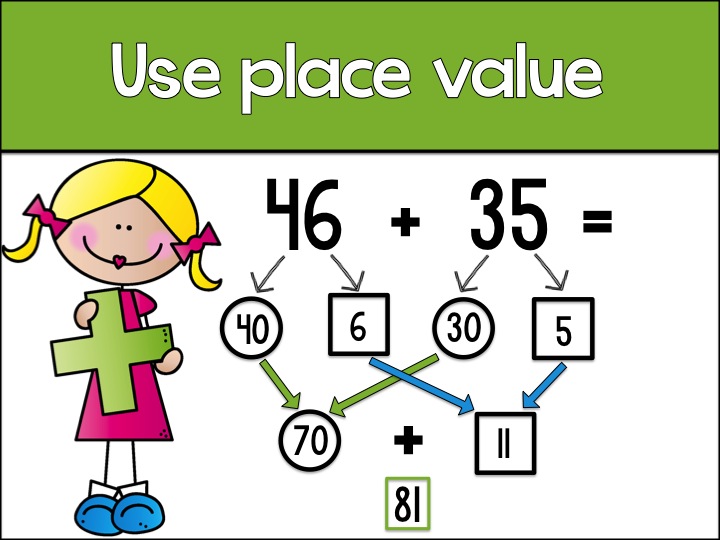
Use place value


This strategy took a little bit more explanation but once students figured out how to decompose the numbers into tens and ones, they were experts at solving sums this way.  I know the poster may look a bit complicated but I found that by using circles and squares for the different place values helped my students.  My students also liked drawing the arrows.

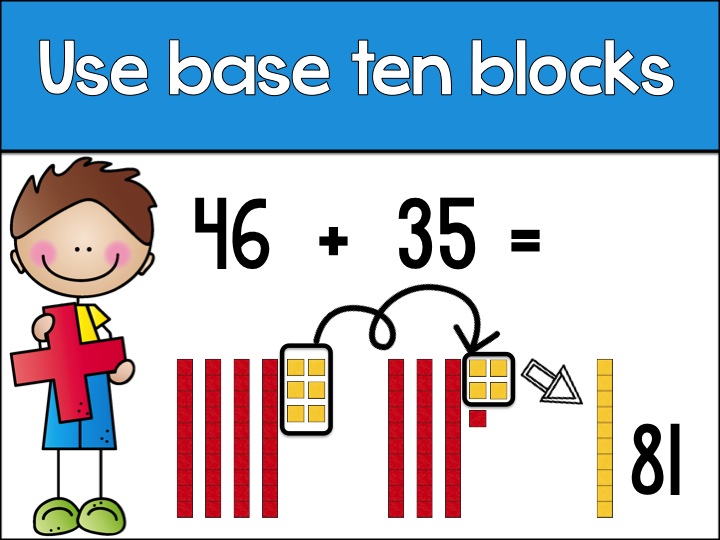
Use base ten blocks


I found for any of my students that experienced difficulty with adding two digit numbers, that this was the best strategy to start with.  I worked at the small table with students using the base ten blocks to solve various problems and it was wonderful to see little lights coming on in their heads as they started to figure it out.  I had a few students who I gave a small ziploc bag of base ten blocks for them to keep at their desk and use as needed.

My students really enjoyed singing and dancing along to this YouTube video as well.  These teachers are great!                                  

You can find a copy of these posters and a booklet with an answer key to practice each strategy here.


Two Digit Addition Strategies Poster and Booklet
You can get this free poster of the more traditional method of two digit addition in the preview.  Just check here.


If you have any other videos or tips you use to teach Two Digit addition, I would love to hear about them.  Now I am off to learn all the different subtraction strategies!


Sunday, March 20, 2016

Celebrating the Arts!

Hi!  I'm Hannah from 21st Century K and I'm excited to share how my school works to celebrate the arts.  In response to new program reviews and standards a few years ago, we began holding an Arts Showcase for our primary students each spring.  


After reviewing the standards we found that while we provided more than adequate opportunities for experiences with visual art, music, dance, and drama in a learning/classroom-type environment we failed to offer our students the opportunity to create, collaborate, perform, critique and explore the arts in their own unique ways.  
So, we encouraged students (and their families) to choose anything creative for which they felt they had special talent or aptitude, and plan a way to present that talent to their classmates.  Then each class held individual performances and voted on which talent/presentation/performance they would like to represent their class in a school wide Create Arts Day Showcase.  No emphasis is placed on winning and losing or who is better/worse.  Our showcase isn't a talent show and very few parents attend. It is simply a way for students to share a way in which they are creative.

What resulted was more than any of our teachers could have ever imagined...

Our young students, as an audience, were respectful, encouraging, and thoughtful. Within each classroom a special story unfolded.   In a second grade classroom an athletic boy puts together a basketball dribbling routine and sets it to music for which the crowd cheers. In one third grade classroom a friend with special needs sings a Michael Jackson song and is unanimously voted into the show where she receives a standing ovation. In another class, a quiet boy shares his amazing computerized robot for which he wrote the programming and is voted into the show over the Broadway show-tune belted out by the girl who regularly participates in local theater performances. In my Kindergarten classroom a typically outgoing and boisterous girl quietly shares a memoir she wrote about her lost pet goldfish and she is hugged by her friends, many of whom are brought to tears.  My own daughter, when she was in second grade, was begged by her class to sing "Let It Go" for the school showcase, encouraging her to overcome stage fright and perform for an audience for the first time in her life. I watched her blossom before my very eyes and was touched to see her classmates give her encouraging looks and a loud, supportive ovation as she finished the song. Many more students played instruments, performed dance routines, and paraded visual arts pieces across the gym.  Each time the crowd of primary students would cheer and clap as if they were at a Grammy-nominated performance.

We all learn a lot of valuable lessons during this week of the school year.

  • As teachers we are reminded that the "extra" stuff (about which we may grumble when it interrupts our comfortable school day routine) is worthy of our time.
  • As regular educators we are reminded that the arts programs are vital to our school and our students (and that the art, drama, music, and PE teachers have a hard job).
  • We learn to view many of our students in a new light... many of which are little diamonds in the rough or have secret talents about which we didn't know.
  • From our students we learn that a little bit of grace and humility can go a long way and that supporting each other by cheering wildly when someone else succeeds is just what friends should do.
  • Interested in starting your own Creative Arts Day?

We send parents a note one week prior saying all students are welcome to participate by preparing any creative presentation including, but certainly not limited to, any visual arts pieces, vocal/instrumental performances, creative writing, dance or other movement routine, anything involving creativity with technology, and dramatic performances or collaborations. Each teacher provides a little class time to discuss projects and ideas, and provides time for friends who may not ave time at home to prepare.  Each class plans a day for class performances and works together to choose one student to perform at the school wide assembly.  Administrators and arts teachers work together to make sure students have all they need and to set a schedule for the school showcase. Then on a Friday afternoon we all gather in the gym to simply celebrate creativity and the arts.

It's simple... after all, the best things in life always are.
Add the Arts to your Common Core instruction in grades K, 1st, and 2nd with this fun unit, "Talents," at 21st Century K on TpT.


Tuesday, March 1, 2016

A Simple Strategy to Review Sight Words

Are your student's struggling to learn their sight words?   Would you like an easy to use system with those students that targets just the words that they need?


I'm Christina from Hanging Around In Primary and I would like to share a simple, yet effective strategy I am using with my students this year.

When teaching sight words I do not have a specific order that I use nor do I follow a specific reading program.  We are fortunate in that we can teach with our choice of resources, so I use a mismash of things I have created, along with purchased resources to teach my students during our literacy block. You can check out a couple of blog posts {HERE} and {HERE} that I have written about the word wall on my own blog.

I believe strongly that students must learn their sight words or word wall words, as I call them, in order to be a successful reader.  Students need to develop an automaticity when reading them.  I want them to be able to read these words without sounding them out so in my classroom we say that these words are like popcorn - they pop right out without having to sound them out.


If your class is anything like mine, even when you spend time each and every week to review the words, some students just aren't getting them.  I needed to catch these kids and provide intervention by targeting the words they didn't know in a systematic way.

First off, I assessed each student and came up with a customized list of words they did not yet have. From this point I determined which words to work on first and prioritized.  Finally, I created customized flip books for each student that would be used to track their progress.


So, how does it work?  Good old fashioned practice!  I send home 5 flashcards at the beginning of the week in a special ziploc bag.  My parents LOVE flashcards - it is familiar to them and easy to do.  I suggest games they can play with the cards but my students often share that they just practice the flashcards.


On Friday I make time to meet with each of my target students (usually during read to self) and do a check in with the 5 words.  If they can read them with automaticity then they get to put a sticker beside the word in their flip book and I stamp their card.  They take the old cards home and I give them new flash cards.  Some weeks students need to continue to practice previous words, so they may only take home 2 or 3 new words.  My students love to put the stickers into their flip books and feel a sense of pride when we review all of the words in their flip book at the end of our check-in session.


I have found this to be a very powerful way to move kids forward in their sight word development.  I have had great parent support with this program because it is both easy to do and takes a little time each night.  

If you want to store this idea away why not pin this image!


Would you like to try it out?  Click below to download a free copy of the flip book to use with your students.


Thank you for checking out my post!