Pages

Showing posts with label K's Kreations. Show all posts
Friday, March 11, 2016

Mentor Texts for Elementary Writing

Hi there! I'm here from K's Classroom Kreations today sharing a few of my favorite mentor texts for writing. I know many of us use read alouds and mentor texts for reading instruction, but they can be a fabulous way to inspire young writers too!

One of the first types of writing styles we commonly look at are narratives. Students LOVE telling stories that are important to them. Here are a few of my favorites:
When I Was Five by Arthur Howard is a cute story about what a child enjoyed when he was five, and what he enjoys now that he is slightly older. Students can easily connect to when they were five and share what was important to them. Making these text to self connections is important when first looking at the way an author presents himself. I like to have students follow the same sentence patterns as the book and write about when they were younger.
Any book by Patricia Polacco is really an ideal mentor text. The story Thunder Cake is great when looking at small moments and something that is so important to the character. After reading the whole story I like to focus in on the descriptive language, words that show sounds, and have students think about a time they were scared of something. What did they do to get through it? The book acts as a great launching point for conversations and writing.

In The Woods by Ermanno Cristini is a book that I have actually had since childhood. I love this wordless picture book for many reasons. I like to model how I can use the images to tell a story. This helps with the concept of words needing to match pictures. I then have students think about a time they they went into the woods. What did they see? I have also used this book when showing students how to start with images before writing. Draw a 4 scene box on a piece of blank paper. Students draw events from a small moment in order and can then use the drawings to help them while writing. A more updated wordless picture book that I love is Chalk by Bill Thomson.
Diary of a Worm by Doreen Cronin is such a cute book! I love showing students how this book is written from the point of view of a worm. The author does a great job of adding in speech bubbles/font choices, comedy, and perspective. We are reading this book next week as our mentor text in both reading and writing and I know my kids will get a kick out of it. I can't wait to see what they come up for their own writing based on this book. Another great book that shows an animal's (ants) point of view is Two Bad Ants by Chris Van Allsburg.
When teaching about how-to writing, I typically show my students recipes, game directions, and any other informational (and hopefully real life) example of directions. The book How to Take Your Grandmother to the Museum by Lois Wyse and Molly Rose Goldman is a funny little fictional story that puts a twist on traditional how to writing. Kids can use the book as inspiration about a time they helped someone. What did they do together? What order did everything happen in?
One of my all time favorite books for word choice is The Salamander Room by Anne Mazer. I absolutely love the descriptive language. I typically use this book in reading when introducing how we can visualize to help us understand a book better. I first read the book without showing them any of the pictures and allow them to draw their own vision. Then, we use it again with the mindset of writers and notice how the descriptive language really pulls us in. Again, students can start with a detailed illustration of a place that is special to them and learn how to use descriptive language to help their audience picture it as well. 
I don't know about your kids but many of mine always seem to "get stuck" when trying to come up with ideas to write about. I have written about ways to inspire and motivate writers before and feel that using mentor texts is just one more way to do this. 

One of my all-time favorite units in first grade is our Cinderella unit! I have literally dozens of different versions from the point of view of animals and people all over the world. Students become familiar with the plot line and learn to predict what may happen next. They can also use this knowledge to help write their own version. I help students map out how a story would flow from their characters point of view with a few questions in mind:
Who is the main character?
Who are the family members?
Where are they trying to go?
Who comes to save the day?
What does the happy ending look like?
A few years ago I had each child make their own book and bound it for them. Last year I wanted to integrate more technology. I had each child make their own book, but then also type their story into a word document. I edited the word documents and printed each out. Students added their best illustrations. I then photocopied all of the class stories back to front (1 page per child). Finally, I printed each set of class stories for every child in the classroom as an end of year gift. Although it did take a TON of ink, every child loved their book and I think it is something that their families can hang on to for years. Students were so creative with stories like Snake-arella, Unirella (unicorn), and Catarella (cats).
 The same could be done with any other series of books that you may have like Goldilocks and the Three Bears, Three Little Pigs, or The Gingerbread Man (another favorite of mine/obsession!).
Another set of books to help generate ideas are by Harriet Ziefert. She has many wonderful titles but Cousins Are for Holiday Visits and Grandpas Are For Finding Worms are two that we enjoy. Students can then brainstorm any other ideas that the author "missed" when writing about the person and create their own versions of the book. They could also write about someone else that is important to them and list all of the reasons why.
When learning about opinion writing I like to use I Wanna New Room or I Wanna Iguana by Karen Kaufman Orloff. We look at the style of the book and how the author uses letters back and forth between characters as the way of telling the story. We also look at how the characters try to convince each other that their opinion is best. Students then try to convince me to do something in the classroom by either working independently or in teams, depending on the time of year. Some ideas have included "I Wanna Have Extra Recess" and "I Wanna Chew Gum".
I really enjoy fairy tales, and also fractured fairy tales. Little Red Writing by Melissa Sweet is a story about a pencil that is trying to tell about Little Red Riding Hood but keeps getting into trouble. The pages are filled with different sized words and fonts, words traveling all over the pages, speech bubbles, fun words for sounds, and tons of expression. Looking at all of the features in this book really helps students see that not all books look the same.
The What If series is so much fun! What If You Had Animal Teeth (or feet, hair, or ears) helps students focus on one topic and imagine how their life would be different. You can then have students write what it would be like if they did in fact have a certain animal's characteristics. Or, students could come up with their own What If you Had... story.
Lastly, when generating ideas, I love to use ABC books as inspiration. Students can easily brainstorm all of the details that go along with a topic. The ABC framework is also simple to use and can be done even in the beginning of the school year. Students could create a class book or individual student books based on abilities. 
I hope you have been inspired by your own library and can look at many of your favorite books through the eyes of a writer! What are some of your favorite books for mentor texts?

If you liked what you read I would love for you to connect with me through my own blog, Facebook page, Instagram, Pinterest, or Teacher’s Pay Teachers store. Thanks again for stopping by! 


Want to put a few of these books on your wish list for later? Pin here:


Saturday, January 9, 2016

Engaging Manipulatives

Hello there! Today I am here from K's Classroom Kreations to share some quick and simple math ideas.
One of my favorite ways to inspire and engage my young students (first grade) is through the use of themed manipulatives. I like to gather seasonal items from craft stores, party supply stores, and dollar stores. I store everything in one box- easy to keep track of and swap out.


Sometimes the objects are seasonal like these bats, eyeballs, acorns, pumpkin beads/pie plates, and jingle bells. I pull them out as the season approaches.


Sometimes I like to use more generic objects as game pieces (cars, dinosaur toys, bugs, mini erasers).


These counters came from a teaching supply store and come in all different themes (ocean, transportation, pets, farm animals, etc.).


I am sure if you search your house or classroom you can find tons of small objects to reuse. We use them as counters when solving word problems, game pieces for themed games, and manipulatives for center time.
One simple math game for decomposing numbers is Bellies Up/Bellies Down where students drop a handful of bug toys (you can give them a number to start with) and then count how many are facing up and down. This helps with finding combinations of a certain number. A variety of counter types could be used. The game can also be played with two different colored items (like buttons or pom-poms). Students can count how many of each color are in a handful or scoop of objects.

Do you have any manipulatives that your students love using? I'd love to hear from you and hope you  can inspire your young students as well!


Wednesday, October 21, 2015

Differentiated Sight Word Practice & Freebie

Hi there! Today I am here from K's Classroom Kreations to let you all in on how I use differentiated sight word lists in my first grade classroom. First of all, let me emphasize the importance of learning sight words, or our "see it and say it" words. I teach my students that they need to save their brain power for decoding challenging words. Sight words are often tricky to sound out and are used so frequently that as readers we are more efficient if we just recognize them instantly. 


I start by assessing all of my students on the 220 Dolch Sight Words. Although my county suggests that we start on List 1, I always start with Pre-Primer and Primer words because many of my firsties come in not having mastered these Kindergarten words. My goal is to see where each child is at to help best meet their needs. I do not want to skip over Kindergarten words for those who need them. At the same time, there is no reason to be giving one of my higher readers basic sight words when they need to be challenged like everyone else. 

Once I have a baseline, I create Sight Word Rings for each student. I simply hole punch the corner of index cards and use a key ring to attach them together. 


I print a label for the front of each set that encourages parents to practice words daily with their children (in line at the grocery store, in the car, before bed, etc.). For your own FREE copy of the labels (to be printed on Avery 2 inch X 4 inch labels, model  #5163 or plain paper) click the image below. Please note, when printing with Avery Labels, the PDF is formatted at the correct size so you may need to click "Print Actual Size" rather than fit to page, etc.
I then select the first 10 words that the child was unable to read instantly (within 3 seconds) and record one per side of the index cards. For students who are really struggling I do not suggest more than 5 words per week. 


The 10 words this child would have on their ring are " down, said, where, new, now, out, saw, that, there, they"


In addition to practicing these words during word work time, students take the word ring home each week and bring it back on Friday for assessment. We also practice grade level sight words daily during our morning routine. However, these individualized word ring lists seem to really help the most. Once students master both sides of the index card (I test with the cards out of order for true mastery) I take the card off and then replace it with a new card and the next unknown words on their list. 


Each month I highlight the words they have mastered in a new color on their overall tracking sheet. As you can see, children are able to work at their own level. It does take a decent amount of time to test each child but I usually try to schedule time with a parent volunteer or assistant for this purpose. Once they get the hang of the routine this is a simple yet meaningful task for them. 

Once a student masters all of their Dolch Sight Words (I have 4 first graders already this year!) I begin them on Fry's Top 1000. I start with list one and repeat the same process as before, just adding new lists as needed. I print multiple copies of the pages from this source here and keep them in a folder, all ready to go. 


Well, thats it! I hope you were able to see how easy it is to differentiate your sight word lists to make it a truly meaningful experience for each of your students. For more ideas be sure to check me out on my blog, K's Classroom Kreations


To save this idea for later, Pin here:


Saturday, August 8, 2015

Creative Classroom Storage Solutions

Hi there! Today I (K's Classroom Kreations) am going to let you all in on a little secret....I have an addiction to containers! That's right. I just love shopping for baskets and boxes and whatever other little containers I can get my hands on. Problem is, I can easily end up with a few too many (and buying new each year isn't a realistic possibility). I'm going to share with you some creative storage options that fill my need to organize and store, without breaking the bank.

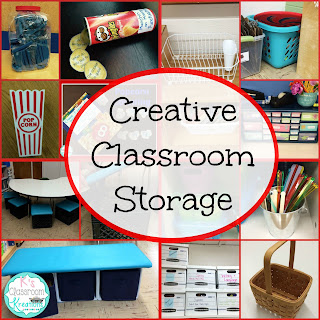
The first type of storage you will find in my classroom consists of recycled food containers. Sometimes I use them to store manipulatives like my Base 10 blocks in the giant Animal Cracker container. Other times I use them as inspiration and storage for simple centers. The Pringles can is holding my Munchin on Punctuation writing center. I also found this adorable popcorn container (bottom left) at the Dollar Tree. I think it could work perfectly with my popcorn counting math activity (but the recycled popcorn box is just as cute!)

I'm sure if you search Pinterest you will see dozens of other ideas like using baby food jars to hold small items or an empty frosting container to organizer bulletin board border in. What I like most about this type of storage is that it adds excitement to the learning. Plus, I am always looking at food boxes now and getting inspiration for future classroom games. Next up on my list will have to be something with Popsicle sticks and a Popsicle box....


As teachers, our brains have a hard time shutting off from the classroom. This is evident in the next ideas where everyday household items take on a new purpose.

First up, the Kitchen aisle! I have used the plastic sink bins (bottom left) for years as open storage to hold books, notebooks, and my "New Kid on the Block" box. This year, after some more Pinterest-ing, I learned about the drying rack option for technology. I am waiting to get my iPads back from over the summer but I plan on standing them up in the rack as a charging station. Best part, the cords won't tangle! Next, I found this sturdy teal laundry basket to keep all of our recess toys in. Items like this are on sale now for College Back to School season (and it matched...and I have an addiction to storage..so I had to have it). Lastly, the toolbox! There are dozens of versions out there to download. I kept mine pretty simple with colored paper, ocean themed stickers, and mini address labels.

Of course I can't recycle and reuse all the time- sometimes (my favorite times) I just need to buy things! I love plastic containers from Dollar Tree for my library, manipulatives, and center materials. Little tin pails have been all the rage at Target this summer - I am storing reading trackers in this little guy (googly eye on popsicle sticks, drink stirrers, highlighting strips). These cardboard banker boxes have been some of my best purchases. I am able to store materials (special books, lessons, decorating supplies, etc.) by season and topic. These were a bit pricier but have held up extremely well for cardboard. Lastly, baskets. I use these for sorting activities mostly but the storage possibilities are endless.

 Last type of storage in my room requires getting a bit creative! I was able to get these milk crates for free a few years ago. I originally covered them in Duct Fabric but redid them in this teal vinyl this summer. Last year I stored my kid's morning work and small group activities inside of them. The bench is simply 3 crates screwed together and spray painted. I like the final look but do not suggest spray painting...black works fine and is a lot less of a pain. You can now find the crates in different colors too. The bench is by far one of the favorite places to hang out in my classroom.
 Just a few more Dollar Tree finds (geesh, I should get a commision for how often I suggest them)! I snagged these little sandwich holders and snack boxes earlier this summer. I plan on using the sandwich containers to put a deck of cards, dice, or other small center activity in. Just the fact that it has Minions or Spiderman on it will make it an instant favorite. The snack containers could be used for the same thing but I plan on using them for behavior. Last year I implemented a token system for a few of my challanging students (read more about it here). I used velcro to stick a plastic cup to each desk but they would still get tipped over. These little containers will hold the tokens and again, the theme makes it even more exciting!
Last up is my pirate themed treasure box. I bought this a few years ago at a craft store (with a 50% coupon of course!). I used it to store materials for my Pirate day at the end of the year. It could also be used as a prize box or simply as storage.

Hope you were able to find a few new storage and organizational ideas. Setting up a classroom this time of year can be overwhelming, especially finding a place for everything. Good luck and have a great year!

For other ideas be sure to check out my blog, K's Classroom Kreations. Thank you!


Want to remember these tips for later? Pin here: