Pages

Showing posts with label 1-3. Show all posts
Saturday, November 7, 2015

Teaching Authors Purpose with Scholastic Order Forms

Hey Ya'll! It's Marcy from Saddle Up For 2nd Grade

Saddle Up for 2nd Grade

Classroom teachers always have old Scholastic reader order forms lying around. They either send way to many or you have stacks that just don't ever get sent out. Why not put them to good use?!? They are perfect for teaching and reviewing authors purpose.

Teaching Authors Purpose with Scholastic Order Forms by Saddle Up For 2nd Grade

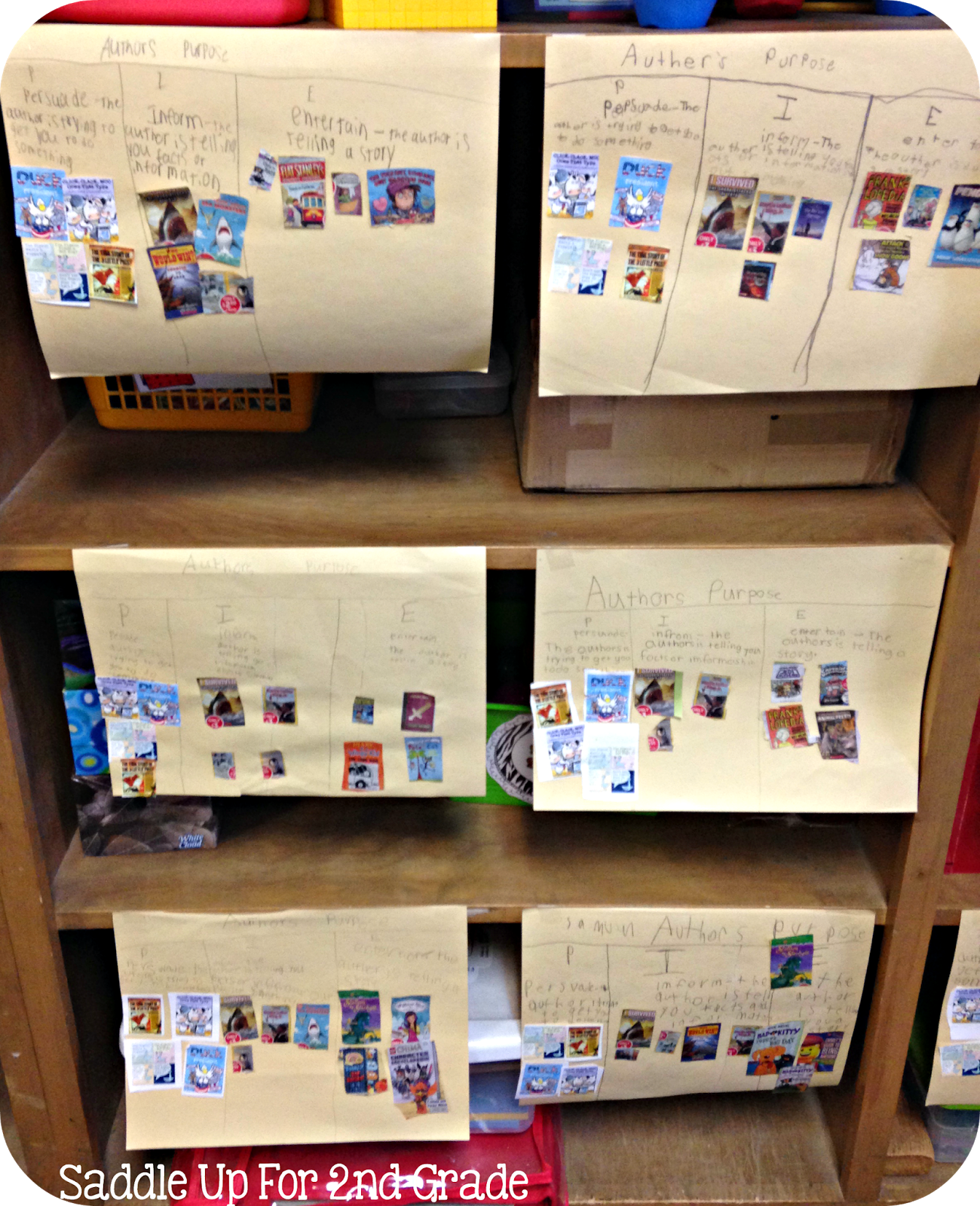
After reviewing the three types of stories, I busted out some old scholastic reading order forms. They created a graphic organizer with drawing paper then they had to find 4 examples of each type and sort them onto their paper. 

Teaching Authors Purpose with Scholastic Order Forms by Saddle Up For 2nd Grade

They did really well with each type except for persuade. This was tricky for them because a lot of the stories in the order form they haven't heard before and I hadn't either. So we brainstormed a list of books that we have read as a class that fall under that category. While they were searching for inform and entertain, I printed off the covers of some of the books we came up with as a class. All of their "P" books are the same but everything else they did on their own. 

Teaching Authors Purpose with Scholastic Order Forms by Saddle Up For 2nd Grade

Teaching Authors Purpose with Scholastic Order Forms by Saddle Up For 2nd Grade

Teaching Authors Purpose with Scholastic Order Forms by Saddle Up For 2nd Grade

This activity was quick, easy, and required NO PREP! Even my lower learners were able to do this without much guidance. It is visual, hands on, and ENGAGING! 

Teaching Authors Purpose with Scholastic Order Forms by Saddle Up For 2nd Grade

So next time you get extra Scholastic order forms, don't throw them away! 


Wednesday, April 15, 2015

Build A Bunny!

Happy Spring!
I'm Deirdre here from A Burst of First.
We had a blast building these adorable bunnies last week!
I had to share them with you!
All the template freebies are at the end!
Grab all the templates for this craft {here}.
Once our bunnies were complete we wrote 
about them on this "Find My Bunny" page. 
At our Open House the kids will read this to 
their families and try to have them find their bunny. 
There are two prompt pages for easy differentiation. 

Grab these {here}.

One last final peek at these super cuties!
I'd love for you to visit me at my blog 
for more fun tips, tricks and ideas!


Monday, March 16, 2015

Math Fact Fluency Races

Hey ya'll! It's Marcy from Saddle Up For 2nd Grade and I'm super excited to be your guest blogger today. I'm going to share with you a fun, engaging way my students like to practice their math facts.

We all know how important is for kids to practice and know their math facts. I try to come up with fun ways to practice so the kids don't get burnt out. One of their favorite games to play is math fact races. This is a twist on the traditional, go to the board, write a math fact, and see how can solve it the fastest type game. Even though I play this with 2nd graders, it can easily be adapted for younger or upper grades.


Here is how it works. Split your class up into teams. I always have two but you can do more than that if you have space. Draw two large circles on your white board. Inside those circles write the numbers 0-10 all the way around. Leave space in the middle to write a larger number. 

*Don't hate on my circle drawing skills. :)

The number in the middle is the main number. They are to add the main number with a smaller number and solve for the sum around the outside of the circle. When I say go, the two teams race to complete adding numbers all the way around. The team complete their facts the fastest, and have them all correct is the winner. 

They do not have to complete the circle in order. For example, they can do 5+2 and write the sum of 7 on the outside of the circle. They pass the marker to the next person and they can do 5+9 and write the sum of 14 on the outside of the circle. The reason I don't have them go in order is for differentiation. I still have some students who struggle with adding higher numbers. This allows the ones to can answer 5+1 quickly to participate without feeling left out. 


After each round, that team gets a point and I change the number in the middle and the game starts over. 


We play this game once a week and they love it. I hope you can use it in your classroom too! It can easily be adapted for subtraction, multiplication, and division facts. 

 You can visit my blog here. Thanks so much for stopping by. :)


Wednesday, March 11, 2015

Learning to Read and Spell Tricky Words

Hello, It's Christina from Hanging Around In Primary.  I am so happy to be guest blogging over here at Who's Who and Who's New.  It is an amazing honor!

I am a first grade teacher and have been for most of my career.  I absolutely love this age, especially the after-Christmas-oh-my-goodness-they-finally-get-it moments! 

Today I want to share with you some tips for teaching those tricky words.  You know the ones; those rule breaker words that our students cannot sound out.  These are the words that they just have to learn to {READ} memorize. I call these words Word Jail words.  


Every week I introduce 5 new words.  We don't have a set list to follow but I have developed my own go-to list and somewhat of an order over the years.  Most weeks the list will include a word that I like to call a Word Jail word - one of those nasty rule breakers. 

When I introduce the words each week we try to sound each word out.  The students quickly discover that the rules we know don't work when sounding out all words.  We then talk about why a particular word is tricky. 


When we take a closer look at each word and apply the decoding skills we have, we find that one or more of our weekly words just can't be sounded out - perhaps it has a silent letter or it has an unusual spelling.  I need to clarify here that a word that my first graders may consider a rule breaker may vary from your first graders or older students.  If I have not taught my kids about the soft c sound, for instance, they are going to cry out that {nice} is a rule breaker - it is, until they know there is a rule for the c sound.  I will put the word in jail if they believe it belongs there.


I believe strongly that kids need a hook to help them to learn to read and this just seems to work.  I find this especially true of the boys and this strategy definitely hooks my boys!  They love the jail. It is located right on the word wall as you can see from the picture above.  They love to put words there.  All of the words we decide are jail words go in "jail" and under the correct letter on the word wall.   Having those tricky words in one easy-to-read spot makes finding them easier, especially for some of those little ones who struggle with the number of words on the word wall.  This way the word can be found in two different places on the word wall.  


After I make a big production of putting a word in jail I like to take a moment to read through all of the words in the jail.  Again having all those tricky words in one place makes review of them much easier.  Throughout the week we will do "find and print" activities where I give them a word and they find and print it on their whiteboard.  My more competent students write a sentence using the Word Jail word.  There are many, many ways to practice sight words but these are some of our favorites. 


I run a modified version of the Daily 5 during my literacy block and I wanted my students to work on those tricky words then as well.  They often use the magnets and sit in front of the Word Jail and make words, they use markers and rainbow write them or make rainbow sentences.  During writing time I often see kids writing and then hear them exclaim "that's a Word Jail word" and run over to the word wall and check it out.  {there are often pencil marks all over the cards from kids pointing a little too closely} Frequently in reading we hunt for Word Jail words and I often see them swing their head towards the Word Jail when they spot one in a book.  Once they spot it in the Jail they are able to read it on the page.  That makes for a very happy teacher. 


I also created a pack of printables that includes 1 sheet for each of 35 word jail words.  Each printable reinforces a number of skills:  copying the word spelled correctly, identifying the correct spelling of the Word Jail word when it is presented with the misspelled version and crossing off the incorrect ones.  The students also have the opportunity to edit a sentence with a Word Jail word spelled wrong and to write their own sentence using the Word Jail word.  Included with this pack is also an editable file where you are able to insert your own words and create your own printable to match the words you would like to use.    

I have been using the Word Jail concept for years and I swear by it.  Kids need to learn their sight words so if I can make it just a bit more exciting, especially for the boys, then I think it needs to happen.  I never get tired of hearing them tell me when we are reading or writing that that they see a Word Jail word.

Thanks for stopping by. I hope you enjoyed reading about how I teach those tricky sight words.  If you are interested you can find the bundle of worksheets and Word Jail display and words here: 


You can find me over at my blog {HERE}.  Thanks for stopping by! 


Tuesday, February 24, 2015

3 Ways to Help Students Master Sequencing

Hello from Michigan! I’m Kelsea, a former 4th grade general education and PreK-8th grade special education teacher turned full-time momma of three (3 yrs and under)! J I blog over at Teacher Gems. I am eager to share some fun ideas with you today to help students master sequencing!


Sequencing is understanding how a series of objects, events, and time occur in a specific and logical order. Because of it’s abstract nature, sequencing can be a difficult skill to master. Yet it is an important skill used in many areas of life. In our daily lives we sequence events such as getting dressed, eating breakfast and going to school. Sequencing is also used across subject areas. We sequence numbers in math, order events in history, sequence steps in a science process, etc. Perhaps the most well-known concept of sequencing occurs in reading when retelling the events of a story.

There are many ways to teach sequencing. Below are three simple methods that will help your students master the skill. Ideally these methods are taught in progression moving through the steps as students become more proficient. However, they can also be taught simultaneously depending on students' prior knowledge and comprehension level.


We naturally sequence in our daily living. A great way to sneak in some extra practice is to intentionally expose students to sequencing without necessarily teaching it. For example, you can use picture schedules (like these free ones) to help students begin to think about sequencing. When giving directions for an activity use simple picture cue cards to illustrate each step (i.e. first color the picture, next cut out the shape and last paste it into your booklet). Put the picture cue cards on a whiteboard in sequential order for students to follow.

Use task analysis to practice sequencing. Task analysis involves taking a simple task like brushing your teeth and breaking it down into step by step instructions. A fun activity to practice this is to have students create posters. Students might make a poster that shows a toothbrush, another poster that shows toothpaste being put on a toothbrush and a third poster that shows the toothbrush brushing teeth. Once students have made their posters talk about them as a class. Can anyone think of any other steps that might be needed for brushing teeth? Try to get students to really think about the details involved such as twisting the lid off the toothpaste, squeezing the tub of toothpaste, turning the sink on, rinsing the toothbrush afterwards, etc. Create a bulletin board with students' completed posters.

Creating an environment of sequencing will give students a jump start to learning this important skill. After introducing students to sequencing through their environment it's time to move on to intentionally teaching the skill.


Helping students master the skill of sequencing will increase their reading comprehension and, depending on how you teach it, will strengthen their writing skills. As a special educator I found that often students who struggled with reading comprehension also struggled with sequencing. When practicing sequencing of a story these students would easily get frustrated with the task and give up. Once students have given up on a task it is much harder to motivate them to try it again. This can be detrimental to learning since mastery of a task takes practice.

Instead of burdening students to come up with a correct answer, I found that students were much more encouraged to try an open-ended task. For example, instead of having my students cut and paste sentences with the main events of the story in order (where if they were incorrect they were stuck!), I created a sequencing sort skill center with picture cards to order. This center allowed students to work on mastering the skill in isolation from reading. So instead of having the picture cards related to a story we read, I came up with picture card sets of three things that went together and let the students write their own story after they sequenced the pictures. This takes the pressure off the student to get a correct answer. While the three picture cards in a set have a seemingly obvious logical order, students can come up with a different order that works for them.


Having students write about the order will give insight into whether or not they are thinking logically about the sequence of events. For example, the picture set below is meant to be sequenced as follows: First you mix together all the ingredients, next you put the pie in the oven to bake and last you take the pie out of the oven and eat it. A child may, however, put the picture of the oven first and in their explanation say, “First you preheat the oven, next you mix together all of the ingredients and last you take the pie out of the oven.” Some might even argue that this explanation is superior to the former (as most recipes call for preheating the oven prior to mixing together the ingredients).


Using picture cards allows students to easily rearrange the images if they think of a better way to sequence them. Having students write their own stories to go along with the picture cards gives the teacher a better understanding of students' thought processes. This in turn will help the teacher to plan more individualized instruction.


Once students have mastered the skill of sequencing in isolation it is time to add the element of reading. Start with three simple pictures that summarize the story and work toward adding more pictures with more details as students become gain proficiency. Practice sequencing as a whole class by placing the picture cards in sequential order in a pocket chart.

Assign students events from a story to illustrate. Have them cut out their pictures and paste them onto popsicle sticks. Then have students come up to the front of the room and arrange themselves (with their popsicle stick) in order of how the events occurred in the story.

Another fun way for students to independently practice sequencing after reading is by using these free story apps. Students listen to a story that is read to them and then sequence four picture cards. Once they have sequenced the pictures they can record themselves retelling the main events of the story.


I hope you have enjoyed reading these ways to help students master sequencing! If you have more tips for teaching sequencing please share in the comments below. If you're interested in using my sequencing sort skill center with your students you can find it by clicking on the image above. Thanks for reading! 


Be sure to stop by my blog and say hello!