Pages

Showing posts with label Math. Show all posts
Wednesday, December 7, 2016

Embracing the Elf Activities

Hi everyone, I hope you are surviving the last few weeks before Christmas break with your students.  It is a hectic time for teachers as we try to keep our students engaged during the day and then work to finish all of our Christmas home projects at night.  Even though it is a tiring time, I love teaching during the month of December.  If your students are anything like mine there is a lot of talk in our classroom about the Elf on the Shelf, his or her pet reindeer or pet dog.  I like to capitalize on my students' interests when teaching.  If they are engaged it makes my job so much easier.  Here are some ways I have embraced the "Elf"

 Math


I am currently teaching data management and pictographs.  To help keep my students interest I decided to put cards with a picture of a boy elf, a girl elf and a reindeer pet in a brown paper bag.  Students take turn drawing the cards out of the bag and using tally marks to record their results.  The students then use their data to make a pictograph.

There is something about using the Elf that suddenly causes all my students to want to see who is hiding in Santa's Bag.

If you think the "Elf" might help you teach pictographs, you can get it here

Language Arts


If you haven't ordered the book "Memoirs of an Elf" from Scholastic you should.  My students love the story and it is a great book to get students writing about Elves and their adventures.  
I love giving students hashtags and having them write about the "Elfie" they made.  Below are just some that I have used with my class.

If you own the book and would like this writing activity, you can get it here.

To help your students write about the Elf and answer that popular question "How do you spell?", you may want to download this FREEBIE.
Hang in there, only ten more days until a much needed break!


Monday, March 7, 2016

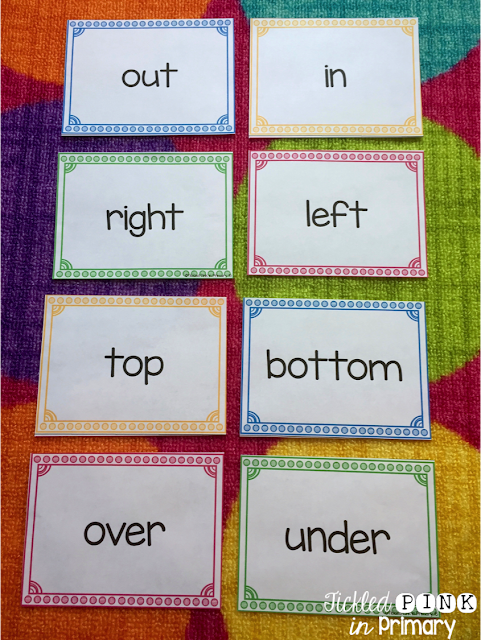
Acting Out Positional Words {FREEBIE}

Positional words are a fairly easy concept for students to understand. Even thought it's a math concept, it can help them expand their vocabulary and use better describing words in their writing too. In the past, I've taught positional words with a student holding a teddy bear counter and having to move it around their body depending on the word I said. I decided to make it a bit more interactive and let the kids work together in pairs and act out their positional word to the class. 
 Students were allowed to use anything in the room as a prop to act out their word.
They thought it was really fun that they were allowed to even stand on the chair and tables if needed!
They had a lot of fun with this activity, so I figured I'd whip up a cuter set of flashcards as a FREEBIE for you! 
You can grab these FREE flashcards in my TPT store! 


Friday, February 26, 2016

Math Games: Helping Students Remember


Hi, this is Brandi, from The Research Based Classroom. I love to use math games for fact fluency practice but I get impatient with students constantly asking me what games they can play or how to play.  It's taken me years to come up with a good solution, but I love this. I just snap a picture of the game when it's all set up and students are playing it. Then I post the picture with the name of the game on the wall. Simple. Students can then look on the wall to not only see what games they can play, but it also gives them a quick reminder of how to play.  It also helps me remember how each game is played from year to year. And best of all....far less questions.


Tuesday, January 19, 2016

3 2 1 Exit Tickets

Hello everyone! It's Greg from Mr Elementary Math.  We all know how important it is to know where our students are, but what can we do to help us figure that out?  One strategy that I like to use to determine student understanding are 3-2-1 Exit Tickets.  They are easy to use and can be very informative.


What Are 3-2-1 Exit Tickets?


3-2-1 exit tickets are a way for students to summarize and reflect on a lesson.  I found that it is a quick and effective tool because it provides feedback on what kids have learned and allows you to see questions that they may have about the concept or skill. 

The students write:
 3 - Things that they learned from the lesson
 2 - Questions that still have
 1 - Idea or thought that stuck with them


How Does This Look in the Classroom?

After you finish your lesson, give students an opportunity to review and reflect on their learning by having them record their thinking on the 3-2-1 exit ticket. 

This activity can be completed independently, in pairs/groups or as a whole class. Early grades teachers may allow students to discuss the ideas with a classroom partner and then verbally share with the class.  After the students share with a buddy, the teacher should record student responses on chart paper or the board.


If you choose to try it out, I would love to hear how it went in your classroom!


Saturday, January 9, 2016

Engaging Manipulatives

Hello there! Today I am here from K's Classroom Kreations to share some quick and simple math ideas.
One of my favorite ways to inspire and engage my young students (first grade) is through the use of themed manipulatives. I like to gather seasonal items from craft stores, party supply stores, and dollar stores. I store everything in one box- easy to keep track of and swap out.


Sometimes the objects are seasonal like these bats, eyeballs, acorns, pumpkin beads/pie plates, and jingle bells. I pull them out as the season approaches.


Sometimes I like to use more generic objects as game pieces (cars, dinosaur toys, bugs, mini erasers).


These counters came from a teaching supply store and come in all different themes (ocean, transportation, pets, farm animals, etc.).


I am sure if you search your house or classroom you can find tons of small objects to reuse. We use them as counters when solving word problems, game pieces for themed games, and manipulatives for center time.
One simple math game for decomposing numbers is Bellies Up/Bellies Down where students drop a handful of bug toys (you can give them a number to start with) and then count how many are facing up and down. This helps with finding combinations of a certain number. A variety of counter types could be used. The game can also be played with two different colored items (like buttons or pom-poms). Students can count how many of each color are in a handful or scoop of objects.

Do you have any manipulatives that your students love using? I'd love to hear from you and hope you  can inspire your young students as well!


Friday, October 30, 2015

Math Challenges - Keep It Simple!

Hi everyone,

It is Teresa here from Games 4 Learning!

I am really excited to be back here blogging on Who's Who and Who's New! 

This time I would like to share with you two of my favorite math challenges. 

Actually they are two of the favorites of my extension math group that I take each week! These are the ones that they beg for! 

The children love them because they are a great challenge and I love them because they are so easy to prepare! The first one is one that I can Can You Make It?

Can You Make It?

Need: 3 sets of small number cards with the digits from 0 – 9, 20 larger cards with 2 digit or 3 digit numbers (Choose 2 digit numbers or 3 digit numbers according to the ability of the players.)

Lay out the number cards face down on the table. Each player will need a pencil and paper.

Play this game with the 2 digit numbers to begin. If children are ready for a more advanced version, try playing with the 3 digit numbers.

One person chooses 6 of the small number cards and displays them for the others to see. They then choose one large card with a 2 digit or 3 digit number. 

Players are now given a set amount of time to create an equation that equals the 2 or 3 digit number. Players can only use the digits on the small number cards and can only use each of these digits once unless 2 or more of the same digit have been chosen.

It is as simple as that!

Here are a few of their attempts.


The next one is a game that I call 3 Rolls to Make 100!

3 Rolls to Make 100

This is a dice challenge that can be adapted to suit different ability levels!

Need: 2 dice, pencil and paper for each player

In this version, players attempt to create 3 numbers that will add to 100 or as close as possible to 100.

To Play: The teacher or a player rolls the dice and tells the two numbers that are rolled.

Players make a 2 digit number from these 2 numbers, e.g. roll 3 and 5 and students can record 35 or 53. Once the number is recorded, it can’t be changed.

Repeat twice so that players have recorded three 2 digit numbers.

Player add these three numbers together and the player who is closest to 100 is the winner.

Play several rounds.

Students use lots of different skills as they choose their numbers and add them. Sometimes working out who is closest to 100 creates a great discussion with more skills required to calculate this. 


Variations of 3 Rolls to Make 100

Addition Games
•5 Rolls to Make 200: Roll 2 dice three times to create three, 2 digit numbers. Add them together. Aim to get as close as possible to 200.

•3 Rolls to Make 1000: Roll 3 dice three times to create three, 3 digit numbers. Add them together. Aim to get as close as possible to 1000.

•2 Rolls to Make 7000: Roll 4 dice two times to create two, 4 digit numbers. Add them together and aim to get as close as possible to 7000.

Multiplication Games
•Roll 3 and Make 200: Roll 3 dice and arrange the numbers in a multiplication equation of 2 digits x 1 digit. Aim to get as close as possible to 200.

•2 Rolls to Make 1000: Roll 2 dice two times to create two, 2 digit numbers. Multiply them together and aim to get as close as possible to 1000.
https://www.teacherspayteachers.com/Product/Math-Games-1842203

Want more?

I have more math game ideas in 5 Fantastic Math Games available in my Teachers Pay Teachers store at https://www.teacherspayteachers.com/Product/Math-Games-1842203

And there are loads more great math game ideas at my blog at Fun Games 4 Learning


Saturday, October 24, 2015

Math Game Boards

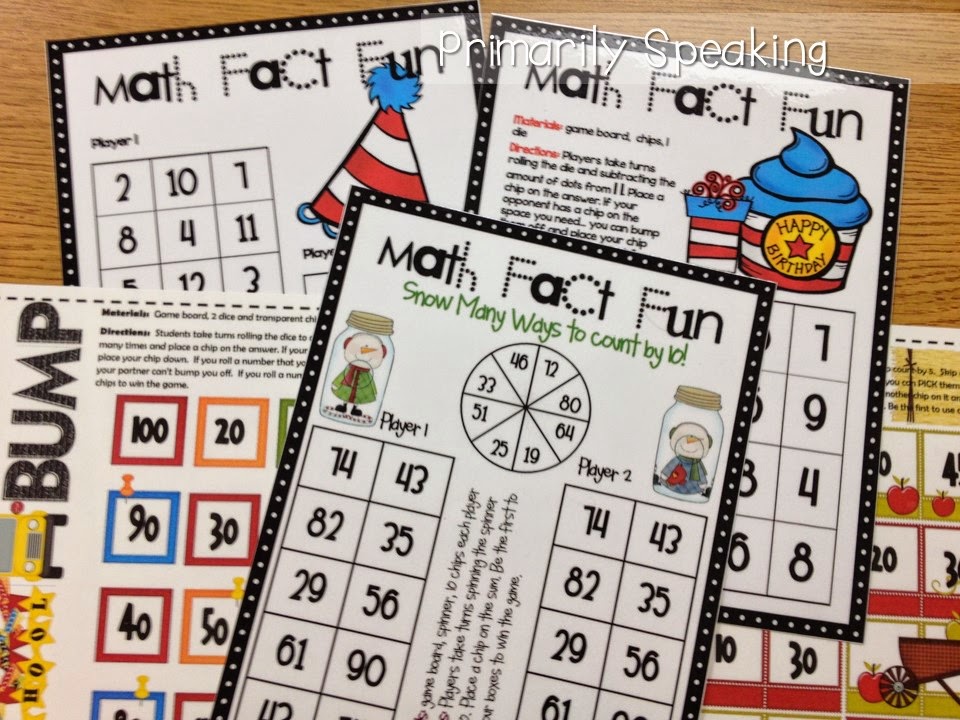
Hey everyone! It's Aimee from Primarily Speaking. Today, I'm excited to share one of my most favorite math resources with you...game boards!


Math game boards are the perfect filler activity.  When I say filler, I mean activities that my students can use once we finish our regular math lesson.  Our district requires that we cover math in a 70 minute block each day.  Sometimes, our adopted curriculum does not take this long (and sometimes, it does).

Game boards are the perfect solution to filling the time because:
  1. They are easy to prep.
  2. They can sit out for weeks at a time (I change mine out at the beginning of each month).
  3. You can use as many, or as few, game boards as you like.
  4. They are a great way to practice/reinforce basic math fact practice and/or other skills.
  5. The students work in pairs which develops their cooperative learning skills.
  6. The students practice the skill of following directions to complete a task.
  7. The students are given the opportunity to use math tools appropriately.
  8. They are hands-on and engaging.
  9. They store easily when not in use (file them or put them in a magazine holder).
  10. The kids absolutely love them!  
I always have the game boards and their materials prepped and ready to go.  Each month, I set out four different games.  I typically make 3-5 copies of each game board.  This allows for plenty of choice/options for the students once the boards are in use.


I place each game board and a baggie with the necessary materials into a small tub. The students can easily grab a board and a baggie and begin playing. I usually let each pair of students choose the game they want to play and they are free to trade for a new game once they finish their first game (and if time permits).


Many of the game boards I use are freebies!  Here are a few of my favorites.

These Bump games from Sunny Days are the best!  To play, the students use dice to add three addends.  The boards are free and there is a different theme for each month.  Each month I put this game out and the kids never, ever get tired of playing. Click here to visit Sunny Days on TpT and search "Bump" using the Quick Find option once you are on her page.


Five in a Row is another popular game with the students.  There is a different theme for each month, and although the rules of the game never change, the boards do.  Best of all the kids never tire of them and they are free!  These game boards can be downloaded for free from the Freebies tab on my blog.


I also love the game boards that Lory Evans creates. The games are high interest and the kids always love them.  Lory has a ton of amazing options (and many of them are free), so be sure to visit her TpT store and check them out!


If game boards are new to you, I highly encourage you to give them a try!  They really are a great way to reinforce those basic skills while keeping your students engaged and on task.  Plus, they are so easy to prep and maintain.

Toodles!


Thursday, October 22, 2015

10 Ways to Use Count Chocula In Your Classroom


Every month I send home to my parents "Mrs. Rosenberg's Monthly Wishlist." I ask for items that relate to our weekly themes. Usually they are items that help enhance our play or centers that I return back to the students. For example, I ask for "tools of your trade" for our Community Helpers unit, a crockpot to make applesauce for our Apple Unit and so on. Sometimes I ask for  particular items that would be donated to our classroom. This is one of those times.

Also, if you are a fairly new teacher (like me) this helps you have engaging props and materials without you having to spend a lot of money.


In October, we do an entire unit around Bats and Nocturnal Animals. On my October Wishlist I asked for 1 or 2 boxes of Count Chocula cereal. My intentions were to use the cereal to make a bat theme sight word center. Well, last Monday, almost all of my students brought in a box of Count Chocula cereal. At first I thought to return the boxes and only keep 2 for the classroom. Then I started thinking of different ways I could incorporate the cereal into my weekly centers. This blog post are the different ways I am using up all this cereal.

1. Count Chocula Sight Words

This was the center that inspired me asking for the cereal.
This is a simple and easy activity. You can type out any sight words (or use my template here) and have students glue the cereal pieces to the sight words. My students loved doing this. They kept saying how great it was that their writing practice smelled yummy! You can also add tweezers to double as a fine motor activity.


2. Count Chocula Math Counters

I used the Count Chocula cereal as math counters for one of my bat counting center. The students used the cereal pieces as counters for their bat math cards. At this point, I let them eat the cereal they used as counters.


3. Count Chocula Bat Mosaic Craft

This is just a cute and fun activity for students. They use the cereal to make a bat. I had them use the marshmallow pieces for the wings and the chocolate cereal pieces for the body.


4. Favorite Halloween Cereal Graph

This is where the other Halloween cereals come into play. We tasted each of the General Mill's Monster Cereals.

You can download the materials here to make your own classroom graph! 

The students obviously loved this activity. There was also amazing conversations happening between each group. I heard a lot of analytical thinking skills from my kindergartners. A lot of them loved the Boo Berry and the Franken Berry cereal but they hated the way the marshmallows tasted. They participated in reasoning skills and math skills.


5. Count Chocula Marshmallow Sort/Addition

This was a quick and fun math sorting activity. I gave the students 1/8 of a cup of cereal and they had to sort the cereal by the marshmallow pieces and the chocolate cereal pieces. We all discovered that there was a significant difference in chocolate cereal pieces than marshmallow pieces. The students were not happy about this! Kindergarten demands more marshmallows!


6. Count Chocula Sensory Tub

You can add the cereal for a fun sensory tub. I do not have a sensory tub in my classroom; however, I found this cauldron and used it for a math center. The students found the hidden bat addition cards. The students loved the style change with their centers. They were happy to have something more than just the cards.


7. Fine Motor Activity

You can use the chocolate cereal and some tweezers for students with fine motor problems to strengthen their finger grasps. I have a student this year who I am constantly looking for different fine motor activities to help him work on his grasp. He is also slower on his centers, so he was thrilled to have a center that was just for him. He practiced moving the cereal with tweezers from two different pieces of paper.


8. Eat the Cereal!

Okay, you try to use all this cereal without one of the ideas to eat it. I can say that I am done with eating chocolate cereal for a long time. 

9. Count Chocula Self-Hardening Clay

This is an activity that I came up with to recycle all the used up cereal from centers. We cannot eat the cereal that they have been playing with and I felt awful wasting all that food. The pictures for this are from me testing the cereal. I will be making this clay in a large batch once this week is over with the left over cereal.

The ratio I used for the clay:
1cup pulverized cereal (no marshmallows!) This was about 4 cups of cereal before going into the Vitamix
1 1/2 cups flour
3/4 cup salt (use table salt, I only had course salt and it took longer to dry)
3/4 cup water (as needed)

Gather Ingredients
Separate Marshmallows 
Place cereal in vita-mix or food processor until it forms a powder 
Cereal Powder
Mix the cereal powder with flour 
Add Salt
Slowly add water and kneed with hands.
Move to counter and kneed until forms the consistency you want. Add flour as needed.

Clay can last 2 weeks in fridge and takes about 2 days to dry.

10. Recycling Cardboard Craft

This activity is not with the cereal itself, but rather with the cardboard from the 15 boxes. We cut circles out of the boxes and used it as a moon for the background of one of our bat crafts. As you can see from #9 I am a big fan of recycling and using up all the materials.


You can grab some of these resources for free by clicking the photo below!