Pages

Showing posts with label Common Core Activities. Show all posts
Saturday, August 15, 2015

Mining for Spelling Patterns


Happy Saturday!  I'm Pamela from Hedgehog Reader, and I am here to share a fun way that students can play with letters and words to discover, practice, and reinforce spelling patterns.


Have you ever played Word Mines?  Maybe you've called them something else...  Basically, here is how Word Mines go:

You are given a word (or sometimes a phrase).  To play, you form as many words as possible in the given time using only the letters presented.  (If there is one R, then R can be used only once in that word.  It can be used once again in another word, and so on.)

Call me a nerd (believe me, you won't be the first!), but this has been one of my favorite pastimes for as long as I can remember.  So it was a natural thing for me to develop Word Mines for my students, because I knew it would be a fun way to identify, discover, and play with spelling patterns!

How to Start:

Although it doesn't take long for students to learn Word Mining strategies and procedures, it does require at least one session of whole class instruction to ensure smooth sailing ahead:
  • Students are ready for Word Mines when they have started to develop phonemic awareness, and have begun to identify common spelling patterns.  They should also have some sight words under their belts.
  • Make sure that any word you give students to "mine" is one that holds plenty of words within it.  Not all words are suited to this activity, so my best advice is to try it yourself first.
  • It's fun to use seasonal words or vocabulary pulled from content areas of current study.
  • I find that controversy is avoided by declaring the following rules:  *No proper nouns   *No foreign words   *No contractions
  • I begin by projecting the word to be mined.  (I've created cute seasonal Word Mines so that I could put them under the document camera, but you can also simply write it up on your board.)  Although traditional Word Mines are done with a word or phrase in its original form, I always scramble mine so that students get the bonus activity of solving the "secret word."
  • Depending on the age of your students, it's often helpful to begin with letter tiles, one for each letter in the scrambled word.  This allows students to physically manipulate the letters (concrete reasoning), until they are ready to move into mentally manipulating the letters (abstract reasoning).  This also ensures that letters are only used as many times as they are found within the word.
  • I model my thinking aloud as I "solve" the projected puzzle.  I make sure to demonstrate how patterns can help.  For instance, if I see the pattern ALE, I will play with each consonant and blend to see if it fits with the pattern to create a word.  Then I move from ALE to EAL and repeat the process.
  • Normally after one such session, students are ready to mine for words on their own, with a buddy, or in a team.


Use Word Mines as a Whole Class:

Once students have a grasp of how to work with Word Mines, these make a great Morning Work activity or sponge activity, either individually, in buddies, or as teams:
  • Students stay even more focused if they know they will have 3 minutes for team consultation to tally up total words once the time is up.  It only takes a moment or two to quickly go through how many words each team came up with  (I am not picky, and the students do a wonderful job holding one another accountable for following the rules), and points are awarded for order of most words found.  For instance - If you have 6 teams in your classroom, the team with the most words earns 6 points, and then work your way down to 1 point for the team with the fewest words - so everybody earns something!


Use Word Mines in a Literacy Center:

Word Mines make a great literacy center activity:
  • Glue a puzzle to the front of a file folder or manilla envelope.  Hide an answer key inside.  Provide a set of laminated letter tiles.
  • Students can record their answers on notebook paper or whiteboards, or on prepared worksheets.
  • It’s best to use only one puzzle at a time to prevent confusion; puzzles can be changed out based on your students’ need.  


I've created this FREEBIE for you to try out a Word Mine with your students!  (I have various seasonal and thematic Word Mine resources in my Teachers Pay Teachers store, and I add to my collection often.)

Have a wonderful year with your students, and thanks for reading!


Sunday, February 15, 2015

Play in the 21st Century Classroom

Hello!  I'm Hannah from 21st Century Kindergarten and I am super excited to be one of the newest contributors to "Who's Who and Who's New!"  I am a Kindergarten-teaching-mom-of-three-wife-to-a-teacher-and-basketball-coach in Kentucky.  My goal as a teacher is to bring Kindergarten into the 21st Century while staying true to teaching strategies that help my young students learn best.

Play in the Kindergarten classroom has become a thing of the past with the advent of higher expectations, new core standards, and the pressures of high-stakes testing trickling down to primary teachers. But, after doing some research for a graduate course this summer and recognizing the needs of my students, 
I decided it was time to bring play back into my 21st Century classroom.  
Each month of this school year I have chosen a new theme for dramatic play and have centered all of my play and explore centers around that theme.  All activities are aligned to Common Core and 21st Century Learner standards, provide for student choice, and give opportunities for those important lessons about social interaction and conflict-resolution.  
By devoting time every week (if not every day) to play, I have found that the sense of community among my students has improved, their thinking and questioning skills are better, and their overall academic performance is higher than classes I have had in the past who did not have as many opportunities for exploration.
Young students NEED to PLAY!
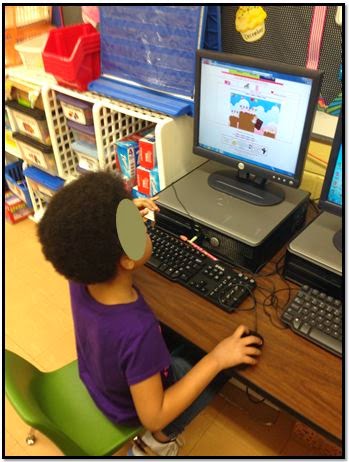
This month our theme is Communication and our dramatic play center is a post office.  Students are enjoying making stamps, weighing packages, paying for stamps, and writing/delivering letters and postcards to family and friends.  At the computers students can play Valentine's Day games and practice typing "emails and blogs" in Word.  At the block center students are creating communication devices including walkie-talkies and cell phones.  I bought a couple of cute dramatic play sets from TpT and have also added some of my own ideas over the course of the last couple weeks.  I generally let the activities evolve as the students play and add to them as they ask for items.
Check out these photos straight from my classroom!


 Next week I plan to add a twist to the communication theme with opportunities to play "Oval Office!"  Students will be able to pretend to be the President, work at a desk, and communicate with their constituents through press conferences on the Smart Board (aka video themselves with the document camera and live-broadcast speeches on the board).  You can kick off your Presidents' Day studies with this FREEBIE from my store,
Grab this FREEBIE!


Friday, November 7, 2014

How can we nurture young readers?

Hello Friends! 
It's Kimberly from Loving Kinders.  I am very excited to be the guest blogger this week.  
I wanted to talk about...
As a kinder-teacher, I find it difficult to find developmentally appropriate guided reading texts. I find that there are a plethora of “ A leveled readers” but do they nurture young readers? Do they offer interaction with print concepts? Can they keep the book and re-read it for fluency practice or sight word retention? In most cases, no. they. don’t. 

As another option, I wanted to share with you what I use and how I support developing readers in my classroom.

I LOVE using Interactive Emergent Readers with my kinders as part of their guided reading curriculum especially, as they develop into confident readers and writers.  By using these texts, kinders are able to develop into self-assured readers with valuable literacy tools that promote and assist them as growing readers.

I’ve found that kinder learners learn best with a GUIDED, Supportive and interactive approach to reading.  There is a reason that “with support” is within our standards!!    Everything we do as instructors is meant to guide and develop our young kinders into self-sustained, confident readers.

This is my simple approach.  I focus on three things.

#1  Identify Conventions
#2  Identify Sight Words
#3  Touch Read and Echoing

In a small group I use a booklet emergent reader.  I make sure that the reader does not have more than 4-5 words per page and that all words are appropriate for my reading group.  I am not too picky with the emergent reader, I just want to make sure that we can write on it and that they can take it home.  Many times I make my own booklet.  For this post, I am sharing my weather reader that I used during my weather week.

We begin with step #1- Identify Conventions. These are the RULES for writing.  I LOVE to color-code. (I REALLY DO!)  I thoroughly believe that color-coding assists students with skill retention and maintains consistency when working with standard specific skills.
I ask my kinders to use colored pencils or crayons to underline the capital letters green and circle the end marks red.  I don’t know where or why I thought of this?  I think it came to me on one of those AMAZING teacher waves that just hits you~ Smack in the face!  Utter teacher genius.  Well, at least for me. Also, I am not sure why it works…but it DOES WORK, and it looks great!  Lastly, I would have to agree that it helps my kinders 100% remember the WHY in the rules when writing and developing sentences.
#2 Identify Sight Words
I l-o-v-e to use color-coding! Did I tell you that already?  Well, in addition to the red and green, my students circle their sight words YELLOW with MARKERS.  First, please know, that I never EVER let my students use markers!!! Why?  Because I don’t like markers, that’s why.  They are fat, they don’t allow for detailed drawings, and lastly, because they bleed through the paper. YUCK!  So... I don't like markers.... So when I read with my kinders in guided reading and they can use a marker to circle their words, it’s like LIQUID GOLD. 
Literally, it is a piece of GOLD!!
It's GOLD I tell you!
 #3 Touch Read and Echoing

This is something that I am sure that you use when you are guiding and supporting young readers.  In our small group each student is required to touch each word and we either read it or tap it out.  After each of the words are read on the page, most likely from one of my readers, we ALL echo the entire sentences ONCE, or TWICE, or however many times we might need.  


This 3-Step Approach supports, guides, and assists readers in their quest and journey to become successful, confident, and sustainable readers and writers. 

I hope these ideas help you nurture our dearest and developing kinders.  Watching young readers and writers begin to read is a priceless gift that we are given as teachers.  There is nothing better than watching a kinder read for the first time. 

Enjoy your kinders.

If you are interested in my weather unit please visit my store and/or my blog.