Pages

Showing posts with label A Space to Create. Show all posts
Sunday, August 23, 2015

Why I used to hate the first day of school...

Why I hate the first day of school and how I learned to enjoy it.


Personally I used to hate the first day of school. Other teachers loved it, I hated it. It was awkward, I didn't know my students, they didn't know me...it was just icky. When I first started teaching I would go through my rules and procedures and watch as my students would fall asleep, get intimidated, or just look miserable. What they didn't know is that I was even more miserable. Ick. 

I had to figure out a way to make it more enjoyable. I was tired of being in tears, literally, at the end of every first day. So I decided to bag the rules and procedures. We could go through that stuff later. I wanted to have fun. I wanted my students to have fun and I wanted to set a creative atmosphere in my room without losing control.

Here are some activities that saved me from hating that first day.

5 Circles and 10 Lines Activity:

I hand out 10" x 10" squares of drawing paper, and show this powerpoint presentation to the students.

I tell them to turn their paper over and I say: 
"We are going to start this class with a creative exercise, because that is what art is all about. Creativity. This should be fun, so try not to stress too much about it, but carefully consider your options and try to come up with a fun or interesting solution to the following prompt. "


Stop there and let the students ask questions.
(I love to see which students will ask questions
and which will just dive in.)


I choose some designs that show examples of the
Elements of Art and show them under the
document camera. We discuss them as a class.
What makes them interesting?

Here is an example of one of my students designs.


This presentation is free on my store, 

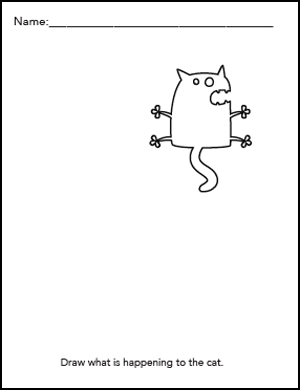
Finish the Drawing Worksheets
I pass out these fun worksheets and get my
students doodling right out of the gate. I found
these by a new seller called iworksheets It looks
like they have a ton of fun stuff to choose from!


What is this frog going to catch?
 Draw what is happening to the cat


It looks like that same seller has some bigger workbooks that can be used throughout the year. Very cool printables and creativity boosters!


Doodle Activity

Think outside the line!
Your assignment is to draw a doodle incorporating the pre-existing line into your doodle. There is no right or wrong, good or bad, just have fun and allow yourself to be creative. Don’t look for the easy way out, make your brain explore all the possibilities! Any orientation whether vertical, horizontal, upside down or sideways is acceptable!


Here is that lesson if you want to grab it.


 Drawing Doodles


Truly these lessons helped me to turn the first day of school from a chore, to an enjoyable experience for both me and my students. I hope you find something that works well for you and your students. Have a wonderful year!


Sabrina Wingren
A Space to Create


Friday, January 23, 2015

Creating meaning: An Artful Approach to Teaching


Creating meaning: An Artful Approach to Teaching

Using art as a vehicle to bring meaning to assignments can improve student engagement and create a classroom culture that is vibrant and exciting.

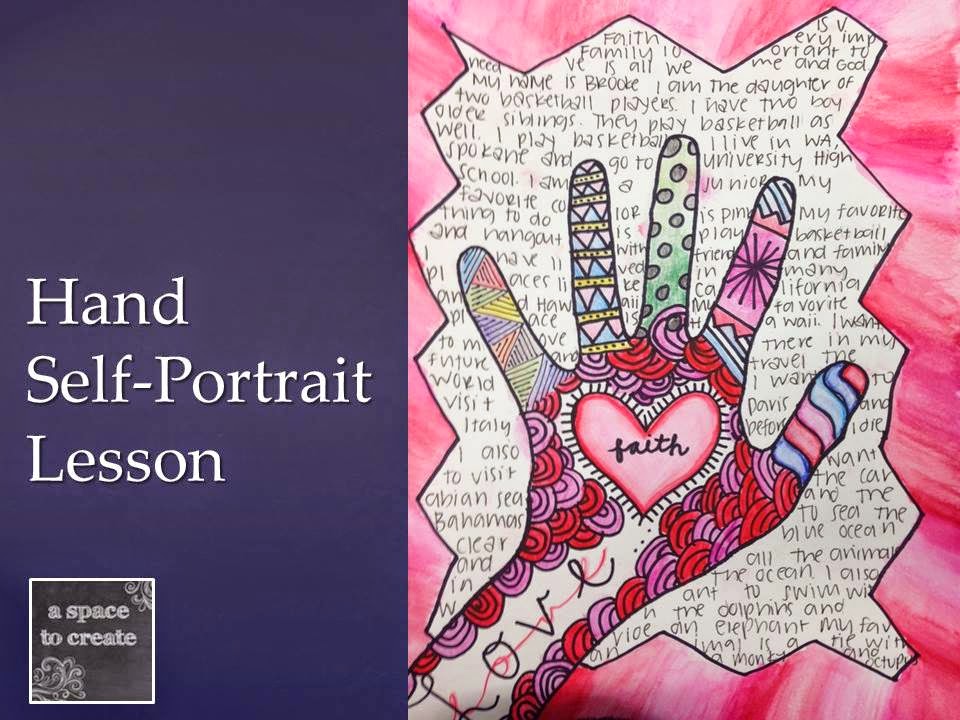
Checkout this Hand Self-Portrait lesson that I use in my art classroom. The English Language Arts teachers have begun to incorporate it into their classrooms as well.

I learn so much about my students with this lesson. It is amazing what they will share with you if you ask them to.

Hand Self-Portrait Lesson:

  • Medium - Watercolor Pencils or Colored Pencils or Markers
  • Project Length - 2-3 days
  • Grade - 3rd grade through 8th grade
  • Subject - Art, Creative Writing, English Language Arts
  • Objective - Create a piece of art using color theory, pattern, rhythm, variety and unity that identifies a core belief about yourself and serves as a self-portrait.  
  • Materials - Watercolor pencils, brushes, water cups, watercolor paper if using watercolor pencils. If using colored pencils or markers, just paper, permanent markers, thumbnail worksheet, zentangle ideas to get started, YouTube videos to use as an anticipatory set.

Start by showing students a video of Zentangles. Here are a couple  that I like, but search and you can find a ton of different examples.

http://youtu.be/R_t_34mchtw
http://youtu.be/56n7_1FGgiw

Step 1:
Students trace their hands with a permanent marker, create a fun border that goes under the hand and then choose a word that they think best describes who they are as a person. Students should write this word in the palm of the hand.

Step 2:
Give students a worksheet filled with squares to practice their Zentangles. I have my students practice at least 6 different patterns. I let them use pencil if they feel they need to for the first 3, but require them to use marker directly on the last 3, so that they can do that for their finished hand.


Step 3:
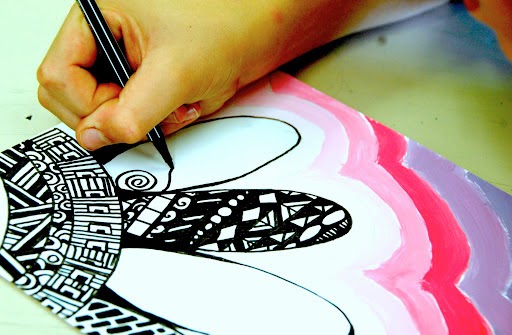
Have students use one of the zentangle patterns in the border area of their hand portrait. I talk about creating rhythm, unity and variety through the use of repetition and patterns and thick and thin lines. Check out my video of that here:


Step 4:
Next have your students add color. We use watercolor pencils, but you can use whatever you have on hand, markers or colored pencils will work great too.


Step 5:
Lastly have the students write out the story of who they are. I have all of my students start with the same line: My name is _________, I am the daughter/son of ___________. And then they take it from there.

Here are a couple of my students work in progress:


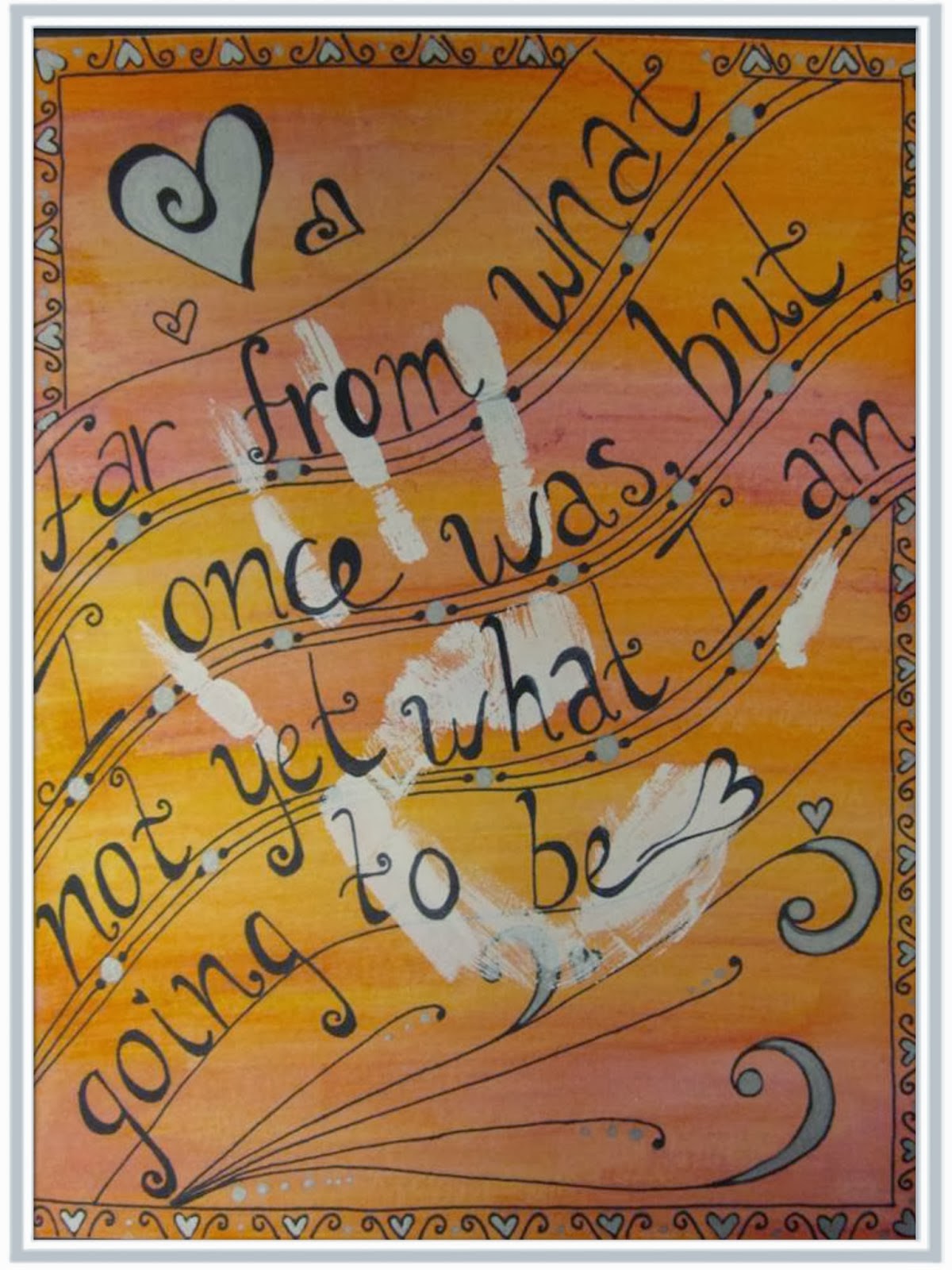
Here are a couple of the finished hands:


Have fun with this lesson and make sure you let the students and yourself just enjoy the process of getting to know one another!

If you'd like to purchase this lesson with the Doodle Idea Starter sheets that includes 12 step-by-step zentangle patterns and a Powerpoint you can find that here:

https://www.teacherspayteachers.com/Product/Hand-Self-Portrait-1664637


See you next time,


Monday, September 8, 2014

When Form meets Function: Classroom Decor


Decorating a classroom isn't just about decoration it is an opportunity to create an environment for students where form meets function and helps define the culture of your classroom.

When I think back to the teachers who were the most influential to me, it is always the teachers who had the most passion for their subject. I still remember Mr. Lindquist reading Shakespeare, face glowing, gesturing with his arms and voice ringing through the room. He was kind of a geek, really, but we all loved him. He made us want to learn Shakespeare, it couldn't be that bad if he was so excited about it, right? I remember posters of Shakespeare and inspirational quotes posted throughout his classroom.

What better way to communicate to your students your thoughts, your beliefs, your expectations, your passion than with posters and pictures of things that are important to you?As an Art teacher, it's easy to decorate my classroom with student artwork, but classroom decor should reach past just decoration and actually create a space where students can feel at home and ready to create. As an English Teacher books will be a key component to their classroom. There is a Math teacher in our school who has large dry erase boards hanging from every wall in his room. It is the perfect example of form meets function.

Classroom decor works best when it also facilitates learning, regardless of what subject or grade you teach. Here are some photos of my classroom. I will post some of Math, Science and ELA later today, I also encourage you to share photos of your classroom.

I teach Art and set up carts for each of the classes I teach. Because I have a different class every period this is essential to keeping myself organized and it helps the students know where to go to get the materials they need to do their work.


Because I teach so many subjects and assignments are large I have green bins that I label with each period for students to turn in their work. This helps me stay organized and students cannot say they turned something in when they didn't. I also have supplies that we use in all classes on this cart.


This is new for my classroom. I set up an area where students can go to grab an object to draw or paint. I included shells, buttons, bones and wooden blocks. I'm going to add sticks and stones and other stuff as the semester progresses. There are also magazines for collage work.


Over the computer area I found posters on Michael's and some cheap frames and hung them on the wall. I like painting that aren't too tight so students realize they don't have to paint as if its a photograph.


To get you started I just designed some posters with the secondary teacher in mind. The posters below are free and will work in your classroom regardless of the subject you teach:

Click on the photos below to download them!


I hope your new school year is off to a great start! Have fun decorating your classrooms! If you have photos or ideas please share them below!

Thanks,
Sabrina


Friday, March 28, 2014

Why Doodle?


http://www.teacherspayteachers.com/Product/Drawing-Doodle-Lesson-141420

How can we afford to "waste" valuable time in our classrooms letting our students doodle?

Sunny Brown gives the current definition of “doodle” in her TED talk, “Doodlers, unite!”:
“In the 17th century, a doodle was a simpleton or a fool, as in “Yankee Doodle.” In the 18th century, it became a verb, and it meant to swindle or ridicule or to make fun of someone. In the 19th century, it was a corrupt politician. And today, we have what is perhaps our most offensive definition, at least to me, which is the following: “To doodle officially means to dawdle, to dilly dally, to monkey around, to make meaningless marks, to do something of little value, substance or import and,” my personal favorite, “to do nothing.” No wonder people are averse to doodling at work."
http://www.ted.com/talks/sunni_brown

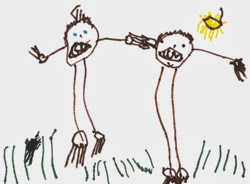
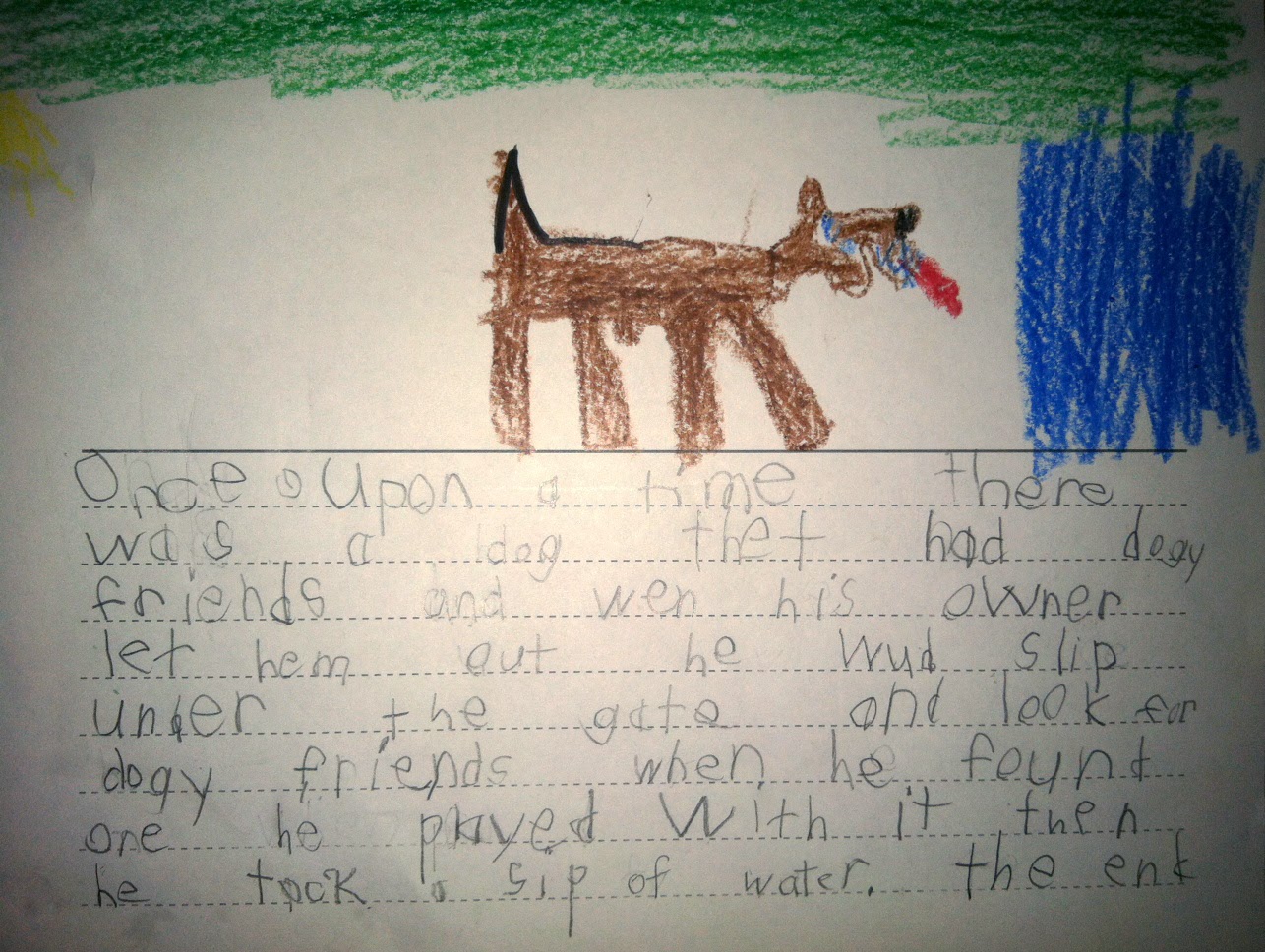
However before a child can speak, they can draw pictures. Drawing helps children understand the world around them and helps them to make sense of the world. When children draw, it is without fear of what others will think, or to try to make a perfect representation of their world, but rather an attempt to communicate and understand what is going on around them. Here's a drawing of friends by a young student.


To take it one step further, the beginning of humankind first communicated through the use of cave paintings and we've learned more about that time from their artwork than in any other way.


So why spend valuable class time doodling?

Doodling greatly benfits our students and gives voice to learners who learn visually. According to Linda Silverman, director of both the Institute for the Study of Advanced Development and the Gifted Development Center and author of Upside-Down Brilliance: The Visual-Spatial Learner, 37% of the population are visual learners.

Doodling helps students retain information. When students read a story or listen to a lecture and  doodle their understanding of that information their retention is increased.

As Sunni Brown states further in her TED talk, re-defining what doodling is:
“Doodling is really to make spontaneous marks to help yourself think. That is why millions of people doodle. Here’s another interesting truth about the doodle: People who doodle when they’re exposed to verbal information retain more of that information than their non-doodling counterparts. We think doodling is something you do when you lose focus, but in reality, it is a preemptive measure to stop you from losing focus. Additionally, it has a profound effect on creative problem-solving and deep information processing.”
In the arts, it allows students to draw without fear of failing and helps them to find their own artistic voice.

It uses abstract thinking skills. With the institution of the common core and it's emphasis on the higher level thinking skills, this is a valuable opportunity for students to use those skills.

How can teachers integrate doodling in the classroom?

Integrating doodling into the classroom isn't as hard as you might think. In Language Arts students can be asked to finish a doodle starter and then write about what they've drawn. I have a doodle starter lesson for elementary classroom teachers.

http://www.teacherspayteachers.com/Product/Doodle-Starters-and-Stories-Printables-291575 

http://www.teacherspayteachers.com/Product/Doodle-Starters-and-Stories-Printables-291575

http://www.teacherspayteachers.com/Product/Doodle-Starters-and-Stories-Printables-291575


When reading a book for class the students can use post-it notes to doodle their ideas or thoughts as they are reading. This allows them to have a better understanding and recall of the story when they are done.

If you click on the image below it will take you to a great blog that explains SketchNotes in a visual way!

Click Here
 
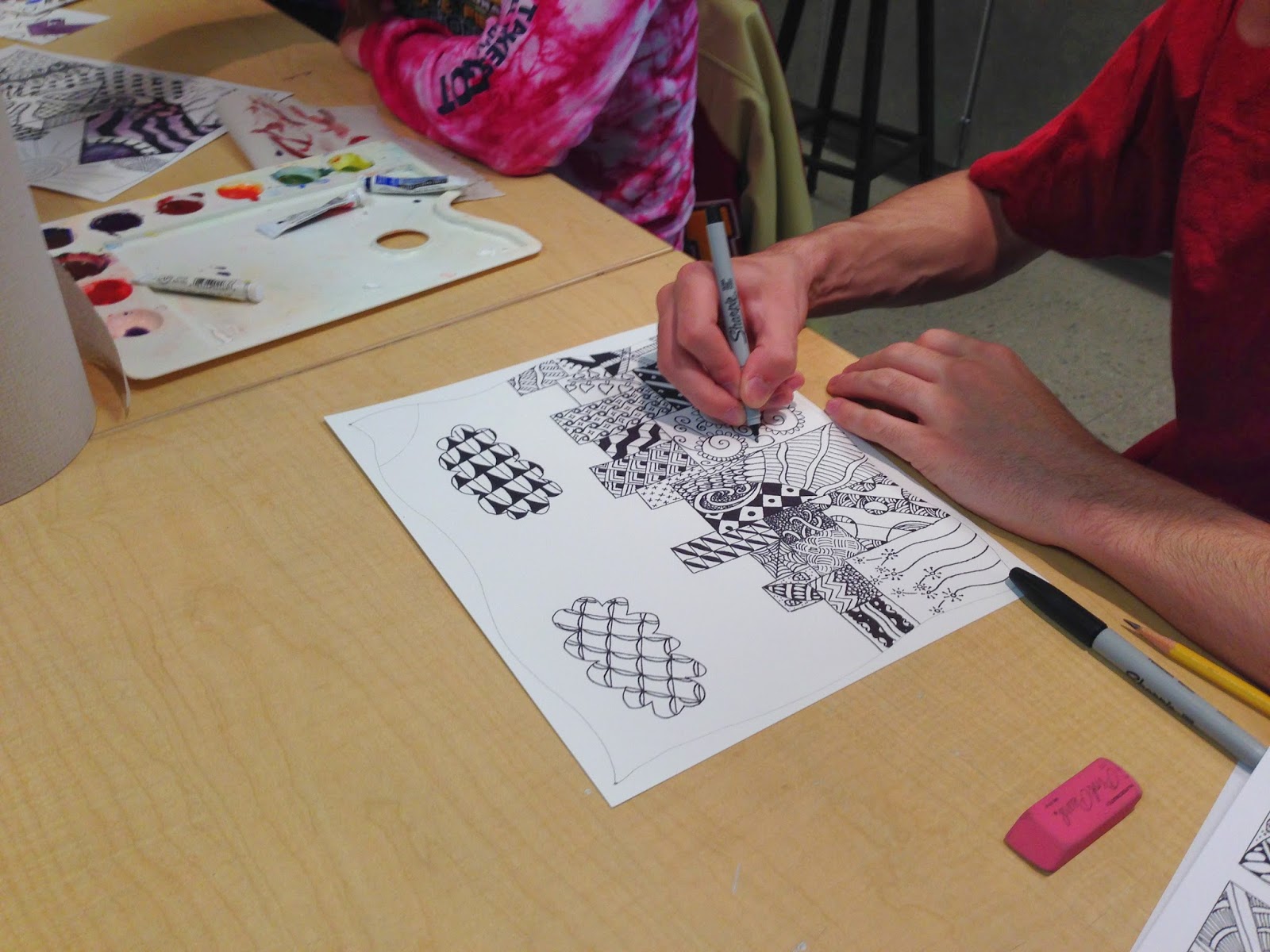
I also teach a doodling lesson in my visual arts class. Here are some pictures of my students working on a more structured doodle lesson,  Doodle Landscapes:

http://www.teacherspayteachers.com/Product/Doodle-Landscape-Elements-of-Art-Project-713796

http://www.teacherspayteachers.com/Product/Doodle-Landscape-Elements-of-Art-Project-713796

http://www.teacherspayteachers.com/Product/Doodle-Landscape-Elements-of-Art-Project-713796
 
Another activity that would be fun for students is to draw flowers, or bugs and then doodle inside the shapes! What a fun, simple craft to celebrate the coming of Spring! Here's a fun blog with step by step instructions on creating zentangle flowers! Check it out by clicking on the image!
 

http://arteascuola.com/2012/10/zentangle-flowers-with-tempera-value-background/
 
You can find lots of great zentangle patterns on pinterest. Here is a board with some zentangle ideas and step by step patterns!

http://www.pinterest.com/sabrinawingren/zentangles/
 
Doodling for fun is a great way to get students warmed up and get their creative juices flowing. The video I put together using visuals of different doodles is free. Access FREE video by clicking on the picture below.
http://www.teacherspayteachers.com/Product/FREE-Doodle-Movie-Anticipatory-Set-142013
 

21st Century Skills

Doodling is about using visual skill to solve problems. Creative problem-solving is one of the most important 21st century skills that our students will need to succeed. Best of all, no student ever complains that the day was horrible because they had to doodle! So can you tell I'm into doodling?! Lol! Take a chance and let your students amaze you with their creativity. Start doodling in your classroom! I'm sure many of you incorporate doodling into your classrooms already, how do you do it?
 
So go ahead, start doodling!

Sabrina Wingren


Saturday, February 15, 2014

The Power of a Growth Mind-set

Recently my a fellow teacher gave me an article to read on mind-sets.The idea of mind-set, and it's effect on success were discovered by Stanford University psychologist Carol Dweck. This is a profound article and my blogpost will make more sense if you read it first. Here is the link to the article: "Mind-Sets and Equitable Education"

In a nutshell the article says that the most important factor to success as a student or as a person is to have a growth mind-set, meaning that regardless of how well you are able to do something at first, you believe that with hard work you can get better. You believe that you will eventually succeed if you keep trying. This has been proven to be more important than I.Q., more important that socio-economic factors, or any other factor in determing success.

I started to think about this growth mind-set as an Art teacher, and how it might effect a classroom teacher as well. I have so many students who come into my class believing before they even begin that they are not creative, that they aren't "good" at art, when in reality anyone can become good at art through hard work and practice. It is only a matter of learning how, just like any other subject. When I tell them this is seems to be a revelation, and it might be for you too! I know that as classroom teachers you also come across students who feel like failures before they even begin.

I was inspired by Rick Carson's book, "Taming Your Inner Gremlin," to create an art lesson that dealt with this fear and that inner critic that keeps us from being the artist, or person we are meant to be. The lesson is done in an art journal style. Students create an Inner Gremlin page full of all of the negative thoughts they have about themselves and about being an artist, they actually draw their gremlin on the page. Then they create a 2nd page that is full of Positive Affirmations. This lesson is intended to help free kids up from the fear of making mistakes and allow them to explore their creativity. I have them give themselves permission to make mistakes. We talk about how often times it is the mistakes that make art beautiful. Here are some of the results:


http://www.teacherspayteachers.com/Product/Journal-Pages-Inner-Gremlin-and-Postive-Affirmations-Lesson-999295

http://www.teacherspayteachers.com/Product/Journal-Pages-Inner-Gremlin-and-Postive-Affirmations-Lesson-999295


http://www.teacherspayteachers.com/Product/Journal-Pages-Inner-Gremlin-and-Postive-Affirmations-Lesson-999295
 
 
This exercise, although I use it in an art classroom, can also be used in your classrooms. Instead of having them write about their negative feelings about being an artist, have them write our their fears and negative thoughts about being a student. It's important that they create a picture of what that gremlin looks like, as well as the written thoughts. Then on the reverse side have them replace those thoughts with positive affirmations, again drawing a positive image as well as writing. It's difficult as a teacher not to judge, or put any kind of evaluation to this assignment at all. They need to have the freedom to mess it up, when you take off the pressure of having to do it perfectly the students will rise to the occasion. Give them lots of examples to use as a jumping off point, and then let them go! It is a powerful lesson for many students and very freeing. If nothing else it opens the door to start talking to your students about the power of a growth mindset.
 
Another lesson that I recently completed with my beginning art class was a self-portrait drawing. My students were overwhelmed with fear of this assignment. We talked about focusing on the process, learning from our mistakes and continuing on our drawing even when it got hard. Nearly every one of the 50+ students I taught were able to complete their portrait and were proud of the result. Here are just a few of the drawings, with a pre-instructional example and a final drawing.


With some instruction and more importantly the belief that they could do it if they continued through the tough parts, they were able to do self-portraits that were amazing. Even my students were impressed with themselves!

I hope you take the time to talk to your students about mind-set, it's such a valuable lesson and I love it when they are able to get past that first hurdle, continue on and then be successful, it's so awesome!

Here is a free doodle movie that might get your kids started on their gremlin/self-affirmations pages!

http://www.teacherspayteachers.com/Product/FREE-Doodle-Movie-Anticipatory-Set-142013
 
Click here if you'd like to use the Inner Gremlin/Postive Affirmation lesson above.

Have fun!

I'm curious, what do you do in your classrooms to encourage a growth mind-set?

Sabrina Wingren - A Space to Create

http://www.artteacherblog-aspacetocreate.com/