Pages

Showing posts with label Spring. Show all posts
Wednesday, March 16, 2016

Spruce up your Spring!

Hi there! I'm Krista from The Knitted Apple back with another blog post on Who's Who! 

Spring is almost here and it’s time for a little spring cleaning.   At home, the first sunny day always inspires change.  I often have grand plans for my change-of-season reorganization, but then reality hits.  I have not been gifted with extra time from a magical time fairy, so I do what I can and move on.

One place I do make time for a little "sprucing" is my classroom.  By this time of the year, name tags are tattered and worn, bulletin board paper is fading, and the classroom just looks TIRED.  I usually devote at least a couple of hours to refreshing the room and it makes all the difference.  I dig out those brand-new pencils, markers, and sticky notes that I stashed back in August, make some fresh new name tags for the kids, and dust off the curtains and shelves.  And while I’m digging through my stash, I inevitably start to organize the area surrounding it, which leads to more cleaning.  My classroom gets the “spruce-up” I imagined for my home.  I don’t mind though, because seeing the happy faces of my students when they spot the new supplies and classroom layout makes it all worthwhile.   


Here’s a little spruce-up I created just for Who’s Who readers! If you use newsletter templates you will love these spring templates I created! These templates are made in PowerPoint and are easy to use.  Just click the image below to download.  You will be downloading a zipped file with two templates and instructions from Dropbox.  FYI- You do not need a Dropbox account to download the files.  If you are asked to sign up, just click the button below that says, “No thanks- just download my files.”  

Enjoy!  


Sunday, February 14, 2016

5 Favorite Read Alouds for Spring

Once the craziness of Valentine's Day ends, I get the itch to look ahead towards spring, and one thing I love to do is pull out some of my favorite books to read aloud to students. Here are a few of my top picks, accompanied by a teaching focus to use with each one.


#1 Tops & Bottoms by Janet Stevens

Tops & Bottoms is the tale of a rabbit who lives on a bear's property. Through a series of cleverly made, self-serving deals with the bear, the rabbit grows and harvests a variety of vegetables, each time taking the crop's best parts for his own family. This time, Bear, you take the tops and I'll take the bottoms. Deal?... and off the rabbit goes to plant carrots and the like.

Use Tops & Bottoms to teach theme. The story contains several, including ones involving work ethic, the lengths one goes to help one's family, and the "little guy" besting the "boss man." Be sure to include the illustrations to help students discover and understand certain themes. For example, the bear wears boots throughout the story, adding to the impression that he is "the big boss." Some say there are even ties to plantation owners and the struggle of slaves, so even though the story is written at a third grade level or so, some pretty deep and meaningful discussions can be brought out.

#2 Muncha! Muncha! Muncha! by Candace Fleming

In Muncha! Muncha! Muncha!, Mr. McGreely does battle against three little bunnies who continue to break into his garden and eat all of his vegetables. Mr. McGreely goes to great lengths to protect his garden... fences, moats, walls, you name it. But the bunnies always figure out a way to thwart his efforts.

Use Muncha! Muncha! Muncha! to teach onomatopoeia. Each time the bunnies break into Mr. McGreely's garden, a slew of snappy sound words accompany the illustrations, showing their sneaky exploits.

If you are interested in my literature unit for Muncha! Muncha! Muncha!, you can see it HERE.

#3 The Gardener by Sarah Stewart

The Gardener is one of my favorite books with which to teach. Set during the Great Depression, Lydia Grace is sent to the city to live with her Uncle Jim and help in his bakery. The story is told through the letters that Lydia Grace writes back to her family. Though at first Lydia Grace is unsure of her new environment, her positive attitude and spirit help to change more than just herself.

Use The Gardener to teach character growth. Though Lydia Grace is the main character, use the details in her letters to infer changes in Uncle Jim. The clues can be subtle, as Uncle Jim never says a word, but the change is profound.

If you are interested in my literature unit for The Gardener, you can see it HERE.

#4 Weslandia by Paul Fleischman

In Weslandia, the main character, Wesley, a sort of social outcast at school, develops (with a little magic, of course) a brand new plant he calls a swist. Wesley's backyard gets filled with the new plant, and Wesley begins using parts of the plant for food, shelter, and various gadgets. Wesley eventually develops products from his plant that he sells to the same kids who bullied him! A whole new civilization is born in Wesley's backyard.

Use Weslandia as a companion to your science unit on plant growth or even in conjunction with your economics unit. (Yeah, it's that versatile.) Integrate engaging projects with students' plant learning, like asking students to develop a new plant of their own, with diagrams and explanations of its parts, needs, and uses. Extend the project into the economics realm by having students use their plant as their natural resource to create imaginary products to sell.

#5 City Dog, Country Frog by Mo Willems

Oh City Dog, Country Frog, how I love thee. Seriously, this simply told, touching story from Mo Willems (yep, the pigeon author) and illustrator Jon J. Muth (how this book didn't win the Caldecott I'll never know), takes the reader on a journey of friendship, at times full of love, and at times heart-breaking. Though the story travels through all four seasons, it begin in spring and ends in "spring again." The text is minimal, but very powerful, which makes it a perfect choice to reread and use multiple times during the year, even with upper elementary.

Use City Dog, Country Frog to teach how to create mental images. (Use it for a lot of things, actually.) The concise style paired with Muth's illustrations compel readers to use their five senses to dig into deeper understanding. After reading and discussing, try rereading the book once more, asking students upon completion to draw and explain their "lasting" mental image, the image seared into their mind that they will remember until they are old. (Yes, it's that good.)

*    *    *

What are some of your other favorite picture books to use during the spring?

www.thethinkerbuilder.com


Saturday, May 30, 2015

Spring Poetry Picture Books

Happy Weekend!  I'm Pamela from Hedgehog Reader, and I'm so happy to be guest blogging again here on Who's Who and Who's New!

With Memorial Day come and gone, it sort of feels like summer already, doesn't it?

But the reality is that we have several weeks left of spring, and I am sticking to that until June 21 - living here in Phoenix, I like to prolong the cooler mindset of spring as long as I can!

Springtime's sensory bonanza provides a palette of colorful language, experiences, and details that our students can pull into their own writing.  And what better way to mentor our young writers through the process than with picture books that feature seasonal poetry?

I've collected nine wonderful titles to share with you today, along with a few instructional tie-ins and activity ideas along the way.


Sun Above and Blooms Below: A Springtime of Opposites by Felicia Sanzari Chemesky and illustrated by Susan Swan

While this book is written in verse - qualifying it for our spring poetry category - it has a bonus:  Every page features at least one pair of opposites.  (Cameo credits to some adorable hatching chicks, another springtime theme that I recently shared a few books and activities for.)  Idea - Create a class book of other thematically-curated opposites in verse!

Did You Hear Wind Sing Your Name?:  An Oneida Song of Spring by Sandra De Coteau Orie and illustrated by Christopher Canyon

Richly written and illustrated in imagery and symbolism that reflects Oneida tradition, this book is described by the author as "a song."  Idea - Discuss various places poetry is found in our daily lives - poems, songs, raps, jumprope rhymes, hand-clapping games, advertising slogans, etc.

Seeds, Bees, Butterflies, and More!:  Poems for Two Voices by Carole Gerber and illustrated by Eugene Yeltsin

My students have always enjoyed the playful interaction required to read a "poem for two voices."  They're also a lot of fun to write with a buddy!   Idea - Challenge students to work in pairs to write and perform their own poems for two voices.

Spring Rain Winter Snow by Edward J. Rielly and illustrated by Angelina Buonaiuto

Haiku is such a natural fit to describe seasons; after all, haiku by definition is poetry to describe our relationship with nature.  Idea - One project my kids have always loved is to paint a nature scene in watercolor, add their own related haiku in permanent marker, and finish it on a student-made scroll.  I will try to write a post about this later; they turn out so beautiful and make a wonderful display.

Hi, Koo!:  A Year of Seasons by Jon J. Muth

Here is more seasonal haiku fun with a healthy dose of friendship tossed in for good measure.  (The author was awarded Caldecott honors for his Zen Shorts.)  Idea - Muth deviates from the traditional haiku format, leading to valuable classroom discussion of poetry form and "rules."

Laughing Tomatoes and Other Spring Poems by Francisco Alarcon and illustrated by Maya Christina Gonzalez

I have a particular fondness for books that provide text immediately accessible in both English and another language.  Children naturally seek to break the code of languages other than their own home language - and quite often the home language is something other than English.  Bilingual books tap into the diversity of language and into our students' natural curiosity about it.  As the title hints, this book features a lot of fun examples of anthropomorphic figurative language.  Idea - Examine as a class how this type of figurative language contributes to the imagery of the poem.  Why does some anthropomorphism work?  (It works when the behavior seems almost believable for that particular non-human thing.)  Why would some not work?  (It doesn't work when the behavior is not even close to being believable by any stretch of the imagination.)  Students work in pairs to brainstorm a list of human behaviors that might be displayed by a non-human thing.  After they select their favorite from their list, they join into a collaborative small-group discussion about why their particular favorite works.

Outside Your Window:  A First Book of Nature by Nicola Davies and illustrated by Mark Hearld

This gorgeously illustrated book features poetry about nature in our own everyday environment.  Idea - Take a playground field trip with clipboards in hand.  Students note examples of nature on the playground (or other nearby locale), and choose from their list to write a Nature Outside Our Window poem.  This makes a great classroom book!

A Stick is an Excellent Thing:  Poems Celebrating Outdoor Play by Marilyn Singer and illustrated by LeUyen Pham

The title says it all!  This fun volume of poetry extolls the value of timeless outdoor pastimes - many of them likely brand-new to some of our students.   Idea - What fun to set up Celebrating Outdoor Play stations that feature jacks, catch, hopscotch, and other activities featured in the book so that students can rotate through and experience these playtime staples for themselves!

Red Sings from Treetops:  A Year in Colors by Joyce Sidman and illustrated by Pamela Zagarenski

This 2010 Caldecott Honor book features a beautifully sensory exploration of color in nature through the seasons.  Idea - Use a web graphic organizer to brainstorm examples of color in nature.  After completing one as a class, students can work on their own or in small groups to generate more ideas.


I hope this list provides you with a new title or two to add to your favorites list - if you have more book or activity ideas, please share them in the comments section!


Sunday, March 22, 2015

Spring Fun

Its been a long winter and we are so excited to welcome Spring this week!
One thing that has helped my firsties this very long winter in New York has been Go Noodle!  This website is amazing!  We exercise along with Maximo several times a day.  This keeps my class excited and full of positive energy.  If you haven't tried this yet you must!  Check it out here:
https://www.gonoodle.com/

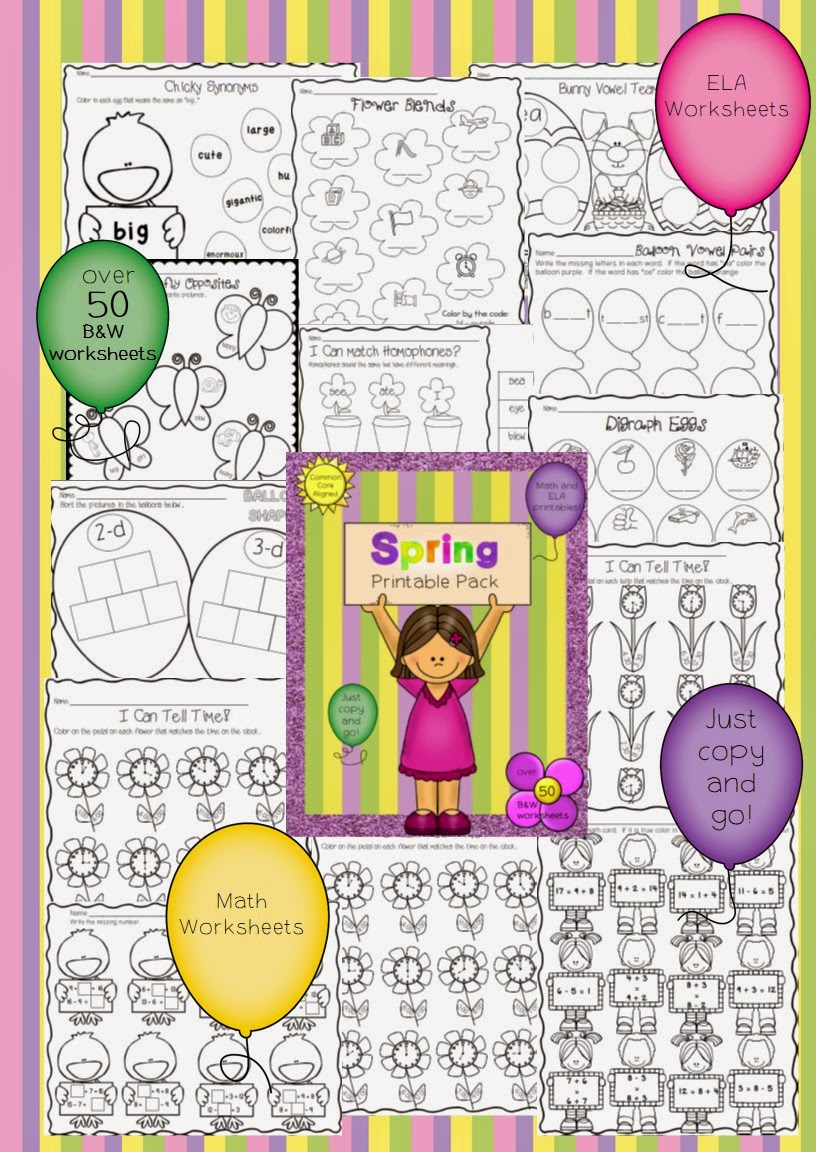
To help with some great Spring activities I made this Spring Printable Pack which is full of more than 50 black and white activities all common core aligned.  These are perfect for morning work, centers, homework, small group, whole group, re-teaching, enrichment and more!
Here are some examples of activities you can find in this pack:
https://www.teacherspayteachers.com/Product/Spring-Printable-Pack-Over-50-Printables-to-cover-tons-of-ELA-and-Math-Skills-1173746
To purchase this pack click on the picture or you can click here.
 
I also like to help my students master the difference between real and make believe.  Here are two fun packs to help your young learners have fun while learning this important skill.
https://www.teacherspayteachers.com/Product/Bee-Real-or-Make-Believe-Activity-Pack-711095

https://www.teacherspayteachers.com/Product/Ocean-Animals-Real-or-Make-Believe-Activity-Pack-711108
 
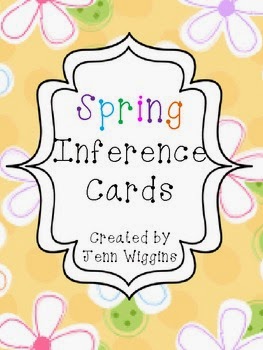
Another fun activity is Inferencing.  This pack includes several Spring Inference Cards that I promise will have your students enjoying this challenging skill.  Plus the pack includes templates for students to create their own!
https://www.teacherspayteachers.com/Product/Spring-Inferencing-Fun-668792
These activities will definitely help bring excitement into your classroom this Spring!
Thank you!
Jenn Wiggins
 
For more activities visit my TPT Store by clicking here.


Wednesday, April 2, 2014

"Egg"cellent Early Literacy Ideas for Spring

I recently visited the dollar store. It was very evident by the colorful Easter eggs, bright-colored grasses, bunnies, baskets and candy that spring is very near. All those bright spring colors flooded my mind with ideas for some fun learning stations. While still in the store, I began to brainstorm ideas for using these inexpensive and engaging materials in new creative ways. Here is a video I created with the 10 early literacy ideas I came up with.


1. Number and Letter Sorting For this activity I used extra small eggs. They were so cute, I could not resist buying them!


2. Syllable Count and Sort In this activity I used regular sized Easter eggs and wrote words on them with a Sharpie. I used three cute bunny baskets I bought at the dollar store, added some grass and printed out some numbers. This is a good activity for students that are beginning to read. They are supposed to read the word, count the syllables in that word and place it the basket that has the number equal to the number of syllables in the word.
http://www.teachingwithnancy.com/free-downloads/

3. Beginning Sounds This is an early phonics activity. To complete this activity students must match pictures to the letters they begin with. When they find a match, they place the picture inside the egg that has that letter written on it. Click on the image below if you would like to use the pictures I put
together for this activity.
http://www.teachingwithnancy.com/free-downloads/

4. Compound Words For this activity all you do is write the first word in a compound word on the top part of the egg and the second word on the bottom half. To make it easier for younger students write the two words on the same colored egg. To make it more challenging, write the first word on one color egg and the second word on a different color egg. To play this game, students choose a picture of a compound word then look for the two egg pieces that have the words that make up that compound word. Once students find the two words, they place the picture inside the egg, and snap the egg together. If you would like to utilize the pictures I used in this activity, clip on the image below.
http://www.teachingwithnancy.com/free-downloads/

5. Rhyming Words Students never get enough rhyming practice. This is such a quick and easy idea for a rhyming center. Write a couple rhyming words on each egg, add a cute basket and you've got yourself a basket of rhymes.

http://www.teachingwithnancy.com/free-downloads/
 
6. Antonyms Are your students learning about antonyms? This is a fun way to practice. How long will it take you to write antonyms on a dozen plastic eggs with a Sharpie? That is how quickly you can put this station together! Want to add an extra challenge? Write some synonyms too.
 
http://www.teachingwithnancy.com/free-downloads/
 
7. Short and Long Vowel Sort Place the little chicks inside the eggs. Students open up the egg, read the word and sort it by short or long vowel. If you'd like to use the words I used, click on the image below to download them.
 
 
http://www.teachingwithnancy.com/free-downloads/
 
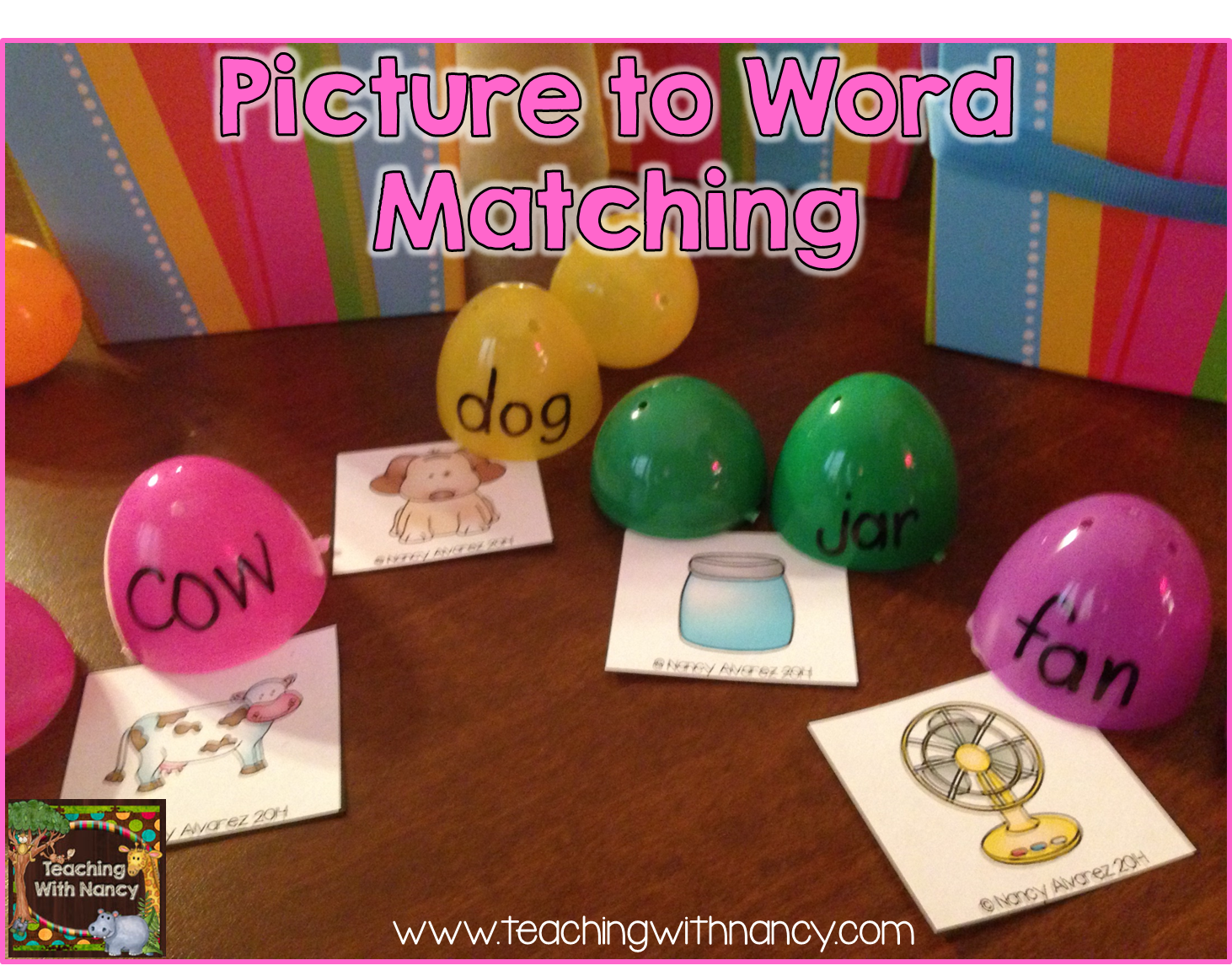
8. Picture and Word Matching For this activity, students choose a picture then they must find the egg that has the name of that picture written on it. Once they find the picture and the egg with the matching word, have them place the picture inside the egg. For this activity, I used the same pictures from the "Egg"citing Beginnings activity.
 
http://www.teachingwithnancy.com/free-downloads/
 
9. Contractions Again very easy to put this station together. Write the two words that make up a contraction on the top part of the egg and the contraction on the bottom half.
 
http://www.teachingwithnancy.com/free-downloads/
 
10. Sight Word Scramble What is Easter without jellybeans? Place jellybeans with letters written on them inside an egg. Students unscramble the jellybeans to reveal a sight word. If you'd like to use this station in your classroom, I have included the jellybeans and answer recording sheet for you . Click on the image below to download your copy.
 
http://www.teachingwithnancy.com/free-downloads/


http://www.pinterest.com/teachwithnancy/eggcellent-teaching-ideas/
 
I hope you have found some fun and inexpensive early literacy ideas to use in your classroom this spring. Now hurry to the dollar store!