Pages

Showing posts with label graphing. Show all posts
Monday, October 26, 2015

Graphing with Dot Plots

This is Krista from The Knitted Apple and I’m excited to be back with another post on Who’s Who.  Today I’m going to talk about one of my favorite math concepts to teach- graphing.   

I find graphing fun to teach because it is often one of the most interactive math concepts.  Students love to participate in class graphs as well as create their own.  

One type of graph I teach my third graders about is a dot plot graph.  Students use data gathered (or given) to plot and interpret information using dots or X’s.  This type of graph is often new for them and adds a little excitement after several years of pictographs and bar graphs.

A perfect way to introduce dot plot graphing is with a class graph drawn on chart paper or on plain paper and displayed on a screen.  I like to survey the class first by asking a question and marking the results using tallies.  Then we use that information to create the dot plot graph together.  

One survey question that students always enjoy is favorite school subject.  Here is the completed frequency table/tally chart:

After gathering the data, we create a dot plot to show the data in a way that is easier to read and interpret. Students can use dots or X’s when placing the data on the graph. I find that X’s are much easier than dots for students to space evenly. 


You can download the examples and blank student survey and graphing pages by clicking the image shown below.

 If you’re looking for additional dot plot practice for your students, I have a Dot Plot Dice Roll resource that is perfect for math stations.  Just click the image below to download it from my Teachers Pay Teachers store.


I hope your students enjoy these fun graphing activities!


Monday, July 13, 2015

FREE Activities to Work on Learning Names

Learning how to write your name is such a big deal when you're little. Many of us still have Kindergarten students coming to school that still don't know how to write their name or write it correctly. It drives me nuts when students come to me writing their name in all capital letters. Who teaches them how to write that like?? I know uppercase letters are easier to form, but that's not how to correctly write a name. I've even had students argue with me and tell me that's not their name when I show them what it should look like. Here are some activities I use to work on recognizing our names, writing our names, and learning our friend's names too. 

To incorporate fine motor skills and name practice, I use toothpicks. Each student gets a paper with their name on it. They then take a toothpick and poke holes through their name. This could be used for sight words, letters, numbers, etc. throughout the whole school year because the students have so much fun with it. 
Once they are done with their name, they can hold it up to the light and it kind of making it looks like their name is shining like stars.  
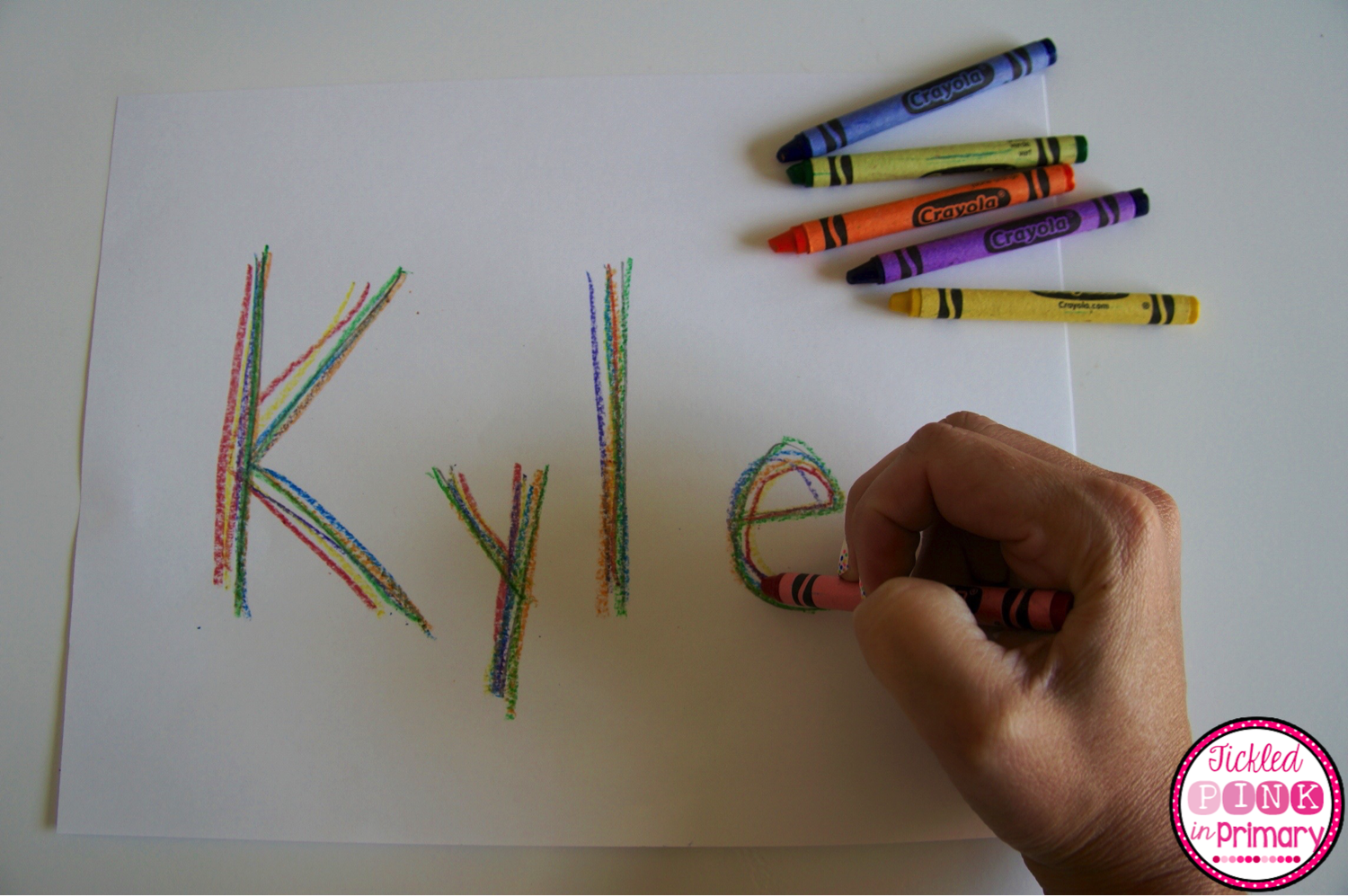
Rainbow writing is such a easy way to practice names. I write their name on a piece of paper and they take turns using different colors of crayons to trace their name. Super simple, yet fun!
I teach students "The Plate Song," to learn their name, but also start to recognize their friend's names. We form a circle on the rug, then sing "The Plate Song" and I throw 2-3 plates on the ground. If a student recognizes his/her name, they get to pick up the plate. So simple, but they love it! The song is very catchy too, so after 2 times of singing by myself, most of the kids have already learned it. 

The Plate Song
tune: If You're Happy And You Know It

If your name is on a plate pick it up, (clap clap)
if your name is on a plate pick it up, (clap clap)
if your name is on a plate, then you're doing really great,
if your name is on a plate pick it up!
Lastly, I incorporate sorting into our name unit. This way I can work on names during reading, writing, and math! I created this FREEBIE for you to use your first few weeks of school. It has many activities included to help students recognize their name, as well as their peer's names. Students can work on counting letters, clapping syllables, and sorting! I write student names on flashcards and use pictures of each student for different sorting activities. At the beginning of the year, you may just have students play memory with their friend's pictures, but later in the school year, they could match the picture to a name. These activities could easily be put in a center tub or pocket chart. 
Click here to grab these activities for FREE!


Wednesday, September 3, 2014

Apple Tasting

Hey everyone! I'm so excited to share with you that I now have my own blog called Tickled Pink in Primary! I took the plunge into the blogging world and am loving getting to share my ideas with you. I'd love for you to check it out and follow my page! 

 
Can you believe it's September already? September is always a fun month in Kindergarten because we get to learn all about apples! I know many teachers are moving away from themes. However, I think you can still do your old themed activities AND incorporate your common core standards. Having a theme can also tie in all of your academics throughout the day. This post will just be a small portion of what we do when we learn about apples. 

We were working on sorting during math, which naturally leads to learning how to  graph what you sorted. I brought in red, yellow, and green apples. First we sorted the apples by color, then by size. We also discussed how they were similar and different. Students predicted what each apple would taste like. Then, I cut up the apples and let students have a few minutes to taste them all. 


They were SO happy to get a snack and compare with their friends how they tasted and which one was their favorite! We are also working on descriptive words in class. I asked them to give me some ways to describe what the apple tastes like, and they couldn't say "good".  Here are some of the words I got: yummy, slimy, awesome, tasty, mushy, crunchy, delicious...


After the apple tasting, I handed out this graphing worksheet. We went around the room and asked each kid what kind of apple they liked the best. I always have to remind them to say how they really feel and not just what their friend picked. :) After each student answered, we colored in our graph to match their answer. As you can see we had to make an extra box since 11 kids liked the yellow apples. 


After graphing our results, we then answered a few questions about the graph. I noticed many students looking at my color posters to see how to spell the colors words. Very resourceful!! As you can see while doing this simple apple tasting activity, we were able to fit in many math and writing skills. 


The worksheets above are included in my Apple Literacy & Math Activities bundle which includes 12 activities that work on reading, writing, math, and science. It's a great way to incorporate common core while still having fun! 


Do you still use themes in your classroom or just units of study?


Saturday, July 12, 2014

Calling All Campers!

     
     Oh, a-camping we will go, a-camping we will go!  A great way to end or begin the school year or for some Summer School fun is to use a Camping theme.  The weather is usually warm (in some places it’s always warm!) and the children are anxious to learn about the outdoors.  We enjoy using a camping theme in our Kindergarten summer school program.  

     We start each morning with a rousing, “Gooooood morning, campers!” followed by a bugle call of revelry!  (Click here to link to a Youtube video with a wide variety of bugle calls.)  Next we make a circle and salute the flag which starts our day.  Then we sing a few camping songs like “She’ll be Coming ‘Round the Mountain”, “The Bear Went Over the Mountain” and “Do Your Ears Hang Low?”.  (We’ve also created several Camping-themed songs so we use those too!) 

      On the first day the children get a name tag that will be used again and again to graph questions on the pocket chart each day.  A morning activity includes asking a question such as, “Have you ever gone fishing?”   A short discussion takes place about the topic.  Then each student answers the question by placing their name tag under the words "Yes" or "No" in a pocket chart.  We talk about the results first and then color a graphing recording sheet to show the class responses.  
Graphing JK Curriculum Connection
Click here to download the Free graphing packet   
        Food fest!  Everyone loves making s’mores when camping!  Since we really can’t have a campfire in the classroom, the next best thing is to use a microwave.  Each child builds their s’more by placing the bottom graham cracker square on a paper plate, topping it with half a bar of Hershey’s chocolate, and 1 marshmallow.  Place it in the microwave for 18 seconds, then take it out and smash the top graham cracker.  Squish!  Be prepared for sticky fingers, sticky tables, and SMILING faces covered in chocolate and marshmallow. 
   
     Now that we've made and enjoyed our s'mores, it's easy to tie that into our camping Math center activities.  This 10-frame math center gives them plenty of practice in adding 2 numbers together.  They just never want to stop pulling those S'more 10- frames out to build problems and find their sums! 
Math Center Camping JK Curriculum Connection
Click here to download the FREE S'more Math Packet
     Another favorite camping activity is “gazing at the stars".  We turn off all the lights and the campers lie down of the floor facing the ceiling under some sight words stars.  (Before doing this activity you have to attach Sight Word stars to the ceiling!) Using a flashlight, they take turns shining the light on the stars and reading the words.  (If you have access to a lot of flashlights, more students can hold them but they should take turns shining them on the words!)  They may write them using clipboards with the recording sheets attached.  Another variation is to have students take turns reading a word and using it in a complete sentence.  At another time, the teacher can shine the light on a word and all students can say the starry sight word together. 
Camping Starry Night Sight Word Activity  JK Curriculum Connection.com
Click here to download the FREE file

      When all their daily work is completed, the campers play board games and puzzles or read books, etc.  We set up a tent in the corner and 5-6 children take in their selected activity.   Since we have a pretty large number of students attending, we rotate the children using the tent so they each get a turn about every 3-4 days.  

Tent Camping in Kindergarten JK Curriculum Connection

     We always plan a field trip to the local library and since it is within walking distance of our school, we tell the kids we’re taking a hike….another camping reference!   In fact, any time we leave the classroom in a line, we “take a hike”.... and sing a song, of course.  Here is an example of a simple hiking song:


March and Sing
(Author unknown, Tune: “The Mulberry Bush”)                                         

Along the trail we march and sing,
March and sing, march and sing.
Along the trail we march and sing,
Along the trail today.


We hope you try a Camping Theme sometime in your classroom.  

It's LOTS of fun!
Click HERE to link to our TPT "store".


Friday, January 10, 2014

Ice-skating In the Classroom

A Friction Experiment

Hello everyone, my name is Nancy Alvarez from www.teachingwithnancy.com.   I am an instructional coach on an early childhood campus.  Prior to that, I was a Pre-K and 2nd grade teacher for 13 years.  I have experience working with a diverse student population, including bilingual, ESL and students with disabilities.  I also have experience with homeschooling.  I love my job because it allows me to coach teachers and help them become even more amazing. 

Today, I would like to share one of my favorite winter lessons with you.  I did this lesson with students to teach them about friction and the scientific method of inquiry.  Although in this example I did the lesson with younger students, it can be easily adapted to suit students from Pre-K thru 5th grade.

I began the lesson by telling students that we would be "ice-skating" in the classroom.   That always got their attention.  After laying some ground rules, we began to experiment and learn about friction. 

I gave them different items to use as "ice-skates" and had them skate around the room in the area I had designated.   For "ice-skates" I used: magazine pages, waxed paper, left-over laminating film and sometimes thin paper plates.
 
Laminating film "ice-skates"
 
Magazine page "ice-skates"
 
Waxed paper "ice-skates"
 
We would try out each set of "ice-skates" for just a couple of minutes.  I always did it with them because it is so fun! 

After trying out each pair of "ice-skates" we created a class graph showing which material they felt made the best "ice-skates".   
 
Our class data graph.
 
Using the data from the graph, we talked about more, less, and equal.  It also led to conversations about why they felt one material was better sliding vs. another.   If you use science journals in your class, they can write about the experiment and discuss friction.  
Ideas for extending the lesson:
  1. Brainstorm other “ice-skating” materials
  2. Come up with other ways to display the data
  3. What surface would work better than carpet?  Why?
  4. Lessons on friction
  5. Write about Ice-skating
 
Below I have included sheets for you to use to conduct this experiment using the scientific method.  Students can complete each part of the investigation forms as you guide the class through this hands-on lesson.  Two levels are included: K-2 and 3-5. 
I love this lesson because it allowed me to incorporate multiple disciplines: science, writing and math.  What also made this lesson a success was that it required my students to all to get up, move and have fun.  
 
download here
 
Now go try it, I can't wait to hear how it goes!