Pages

Showing posts with label science experiment. Show all posts
Wednesday, April 29, 2015

Experimenting with Apples

It's science fair time again and we have been working on our project.  We used the scientific method to guide our experiment.


We began by talking about our problem.


Then we formulated a question.


And a hypothesis.


Next, we each made a prediction.


Then we conducted our experiment.


I prepped by dividing paper plates into 4 parts and adding the names of the liquids.


Then we dipped the apple slices into either soda, milk, lemon juice, or water and placed them on the plates.

Then came the hard part for my Kinders ... waiting!

We waited an hour and then observed the apple slices.


The differences between all of the slices was very subtle, but we did find that dipping an apple slice in lemon juice slowed down the browning process.

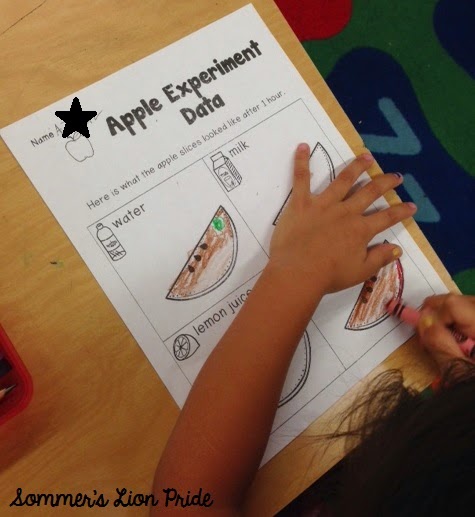
We recorded our results on this sheet.

Here is our display board, all ready for the Science Fair!


Friday, January 10, 2014

Ice-skating In the Classroom

A Friction Experiment

Hello everyone, my name is Nancy Alvarez from www.teachingwithnancy.com.   I am an instructional coach on an early childhood campus.  Prior to that, I was a Pre-K and 2nd grade teacher for 13 years.  I have experience working with a diverse student population, including bilingual, ESL and students with disabilities.  I also have experience with homeschooling.  I love my job because it allows me to coach teachers and help them become even more amazing. 

Today, I would like to share one of my favorite winter lessons with you.  I did this lesson with students to teach them about friction and the scientific method of inquiry.  Although in this example I did the lesson with younger students, it can be easily adapted to suit students from Pre-K thru 5th grade.

I began the lesson by telling students that we would be "ice-skating" in the classroom.   That always got their attention.  After laying some ground rules, we began to experiment and learn about friction. 

I gave them different items to use as "ice-skates" and had them skate around the room in the area I had designated.   For "ice-skates" I used: magazine pages, waxed paper, left-over laminating film and sometimes thin paper plates.
 
Laminating film "ice-skates"
 
Magazine page "ice-skates"
 
Waxed paper "ice-skates"
 
We would try out each set of "ice-skates" for just a couple of minutes.  I always did it with them because it is so fun! 

After trying out each pair of "ice-skates" we created a class graph showing which material they felt made the best "ice-skates".   
 
Our class data graph.
 
Using the data from the graph, we talked about more, less, and equal.  It also led to conversations about why they felt one material was better sliding vs. another.   If you use science journals in your class, they can write about the experiment and discuss friction.  
Ideas for extending the lesson:
  1. Brainstorm other “ice-skating” materials
  2. Come up with other ways to display the data
  3. What surface would work better than carpet?  Why?
  4. Lessons on friction
  5. Write about Ice-skating
 
Below I have included sheets for you to use to conduct this experiment using the scientific method.  Students can complete each part of the investigation forms as you guide the class through this hands-on lesson.  Two levels are included: K-2 and 3-5. 
I love this lesson because it allowed me to incorporate multiple disciplines: science, writing and math.  What also made this lesson a success was that it required my students to all to get up, move and have fun.  
 
download here
 
Now go try it, I can't wait to hear how it goes!