Pages

Showing posts with label behavior. Show all posts
Tuesday, January 20, 2015

Kids, Yoga, and the Brain


Friends~Yoga is an incredible exercise for both the brain and the body.  That is why I love that at my school ALL students have PE everyday and one of those days is a YOGA class.  
(We even have recess too!)
Yep! That's right! Grades K-8. 
Once a week, my students head to our yoga room, take off their shoes, and roll out their mats.  Why? because we want our students to connect their brains to their body movements! We want our students to be healthy active learners.  
Yoga is a fantastic way for children to activate both sides of their brains.  Many yoga poses encourage cross body motions that strengthen the connection between the right and left hemisphere of the brain. 
The right side controls emotions and creativity while the left side handles more logic and numbers.  When both sides of the brain are activated learning becomes easier.  

We all know that students these days are feeling the stress of testing in the classroom.  Some schools are even considering limiting or getting rid of recess!

Yoga allows them to focus on their breathing when stress enters their bodies.  The breathing encourage a release of that stress.  Students that are active and learn to understand their bodies are more confident and able to handle what life throws at them.  

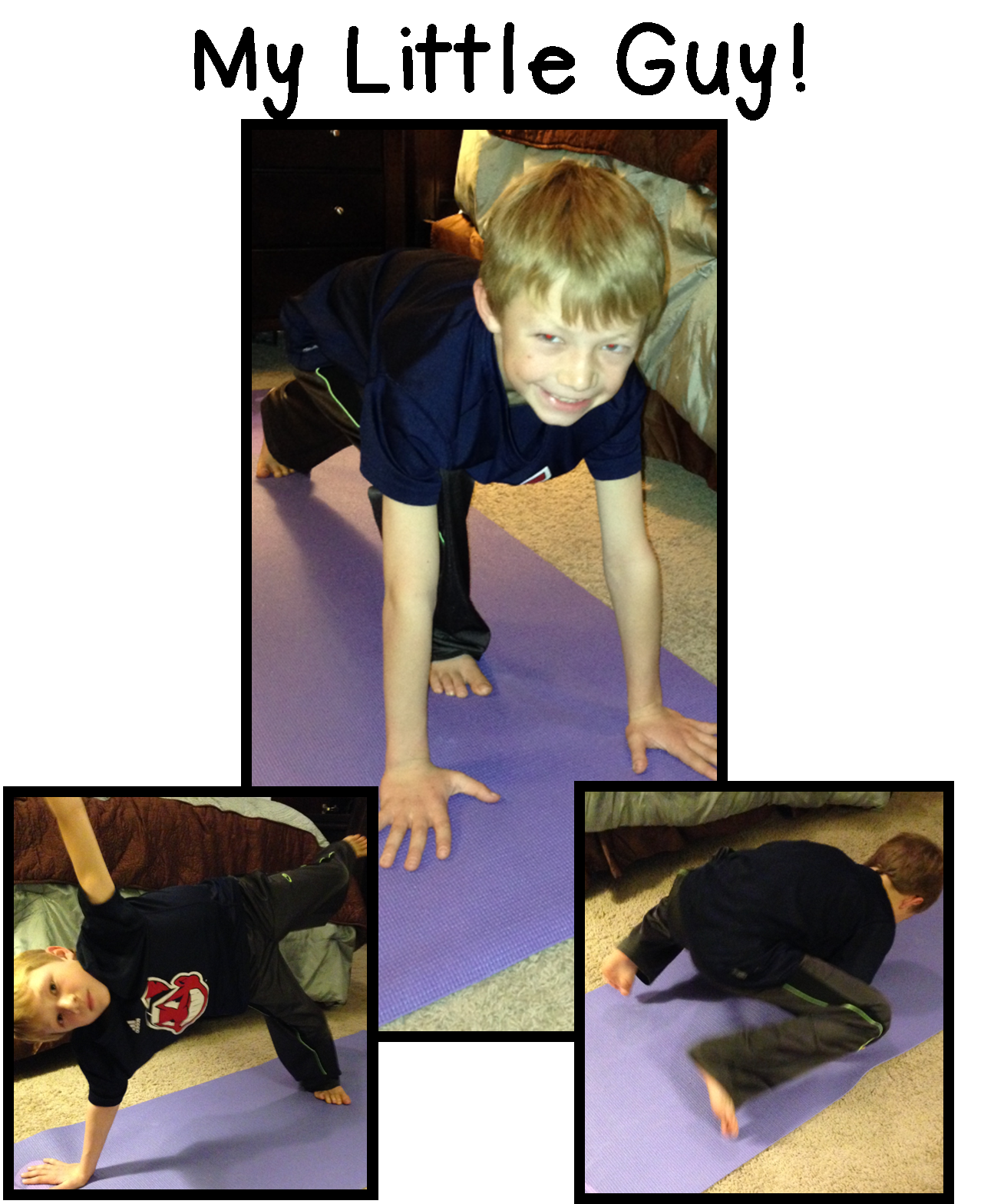
I know from my own daughter, the stress level for our young teens at school can be intense. She relies on the focused breathing that she has learned in yoga to stay in control both at school and on the softball field.  My 3rd grade son loves yoga and was so excited to show you all some of the poses he has learned in school. 


Click the video to see him in action! 

As a teacher, I see the benefit in the classroom     everyday.  We use some of the yoga breathing and cross body activities during our morning meeting and at the end of the day.  My first graders are more focused and centered after their yoga class and it is great for brain breaks in the classroom.  
If you don't have yoga in your school, I encourage you to add it into your weekly routine.  This is a simple video to get you started! 

I just love this poster!  
ABCs of Yoga has some great resources!


~A Yoga pose a day keeps the stress away!


Sunday, March 30, 2014

Personal Space Camp

Happy Sunday, everyone!  It's Lisa from Second Grade Stories coming to you from a VERY rainy New England.  I can't complain though - at least it's not 20 degrees and snowing!  Spring has finally begun to show up around here and nowhere is this more evident than in my classroom... with my kiddos' behavior... argghhh!
 
We definitely have some spring fever going on here and that means it's time to review and role play some social skills again - just enough to keep us going for the next three months.  (Yes, that's right... mid-June is our last day!)  My seconds have been SO all over each other lately - poking, tattling, interrupting... it makes the day so much more tiring and even they are feeling it.  So, I decided to jump right in and help them fix this so we can be a happy and productive classroom again. 
Welcome to
But before I share, let me explain how this all fits in.  (And I apologize for the lack of photos in this post - I'll try to get creative and put some in as much as I can!)  We all know how important teaching social skills is as part of our classroom.  Not only does it help keep things running smoothly during our day at school, but those same skills are an integral part of being successful out in the world.  I have an outline for the year of social skills for us to focus on - things like being a good listener, staying focused on your own work, taking turns and working together.  We focus on one skill for 3 or 4 weeks, doing most of our activities during morning meeting and then reinforcing throughout the day.  The first two months of school focus on:

I have a general plan of when we'll do others, but many times it depends on how things are going in class and what I see a need for.  Like now - we definitely needed to focus on two specific skills again - personal space and not interrupting.  I tackled personal space first, since I thought (hoped!) maybe reviewing that one would have an impact on everything else.  I enlisted the help of our fantastic school psychologist intern and we got to work. 
 
We started by reading this book - it is a must have for any elementary classroom!!! 
http://www.amazon.com/Personal-Space-Camp-Julia-Cook/dp/1931636877/ref=sr_1_1?ie=UTF8&qid=1396102429&sr=8-1&keywords=personal+space+camp+by+julia+cook

Had I known about this book, I would definitely have used this at the beginning of the year.  (Already bought it from Amazon for next year!)  It's all about Louis, who has some issues with personal space (described SO perfectly from a kid's point of view!)  He's been asked to join a group that works on "space camp" - and he's ready to go because he knows a ton about outer space.  Louis is a little disappointed to discover that it's not THAT kind of space being talked about.  But, he learns a lot and even shares what he discovered with his family.
 
After the story and some discussion about what personal space means, we started talking about strategies for knowing the boundaries of your personal space - in line, on the rug, at your table, etc.  We brought out hula hoops for everyone and asked them to sit themselves on the rug, inside their hula hoop, in their own space.  AMAZING!  Kids who usually ended up on top of each other saw that you really CAN fit everyone on the rug comfortably.  After a few more quick activities (stuffing LOTS of kids into one hoop!) and role plays (how do you handle when someone is a "space invader?"), we moved the discussion to how personal space is different depending on the situation.  Sitting at tables means less personal space than a hula hoop, and in line is even less - but we modeled and role-played so everyone had a clear idea of what personal space meant.
 
At the end of the activity, each student received a "personal space camp" award.  Boy did they eat that up!  We told them that meant they knew everything about personal space and now they were expected to show it.  Here's the one I created.  You can click on it to use it with your own kiddos.
https://drive.google.com/file/d/0B2ize_mAbVGMQXBwYlZqVlJZY1E/edit?usp=sharing

I can't say this completely fixed our personal space issues, but it made it easier for students to talk to each other about staying in their own space, using the hula hoop idea.  And it gave us a common language to use in our classroom.
 
Julia Cook, the author of this book, has MANY more great books on social skills that are perfect to use with elementary kids.  I own a ton of them.  They are written in a way that students can connect and some of them have an activities guide to go with them - perfect for classroom ideas.  Visit her website to see all the books she has.

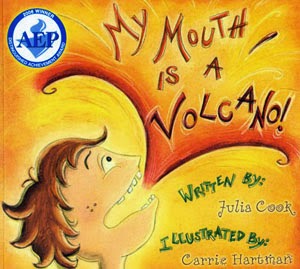
I have also used the book
http://www.amazon.com/My-Mouth-Volcano-Julia-Cook/dp/1931636850/ref=sr_1_1?s=books&ie=UTF8&qid=1396134827&sr=1-1&keywords=my+mouth+is+a+volcano
 
to work on interrupting.  Everyone has SO much to say and it is important for kids to know there is a time and a place for when to share things.  This book gives great strategies to hold those words in until it's time to share your ideas.  My kiddos LOVED practicing the strategies (lots of snorting going on here - you'll see!)  As I was hunting for ideas to use with this book to make our lesson more hands-on and give students something to refer to, I came across a great blog called Speech Room News. 
http://thespeechroomnews.com/
Jenna is a pediatric speech language pathologist who works with students in an elementary setting.  Her blog is filled with ideas on teaching social skills in the classroom.  We used her volcano craft to follow up on our interrupting lesson.
http://thespeechroomnews.com/2013/10/int-erupter-social-thinking-activities.html#
We decided to write strategies we could use to stop interrupting on our volcano strips so students could refer to them as needed.  For the next week, our volcanos sat in our room and you could see everyone trying hard not to interrupt.  All I had to do was say "volcano" when someone interrupted and immediately everyone smiled!  On Friday, students took their volcanoes home, along with a quick note from me explaining what they were and how to use them.
 
Although working on these social skills takes time out from our "academics," it really pays off in the long run.  I'm looking forward to using more of Julia Cook's books (and Jenna's ideas!) in my classroom.  What great ideas do you have for working on social skills in the classroom?


Monday, February 10, 2014

Increasing Positive Behavior

Hey everyone! I'm excited to write my first post ever! I'm a Kindergarten teacher from Indiana. I do not have a blog of my own, but you can visit me over on my Facebook page or TPT store. I'm very thankful to Hilary for this opportunity to collaborate with other teachers and share some ideas with all our blog followers!
A few of my favorite things that I do in my classroom are my clip chart and Behavioropoly. This behavior system helps the classroom have a more positive environment. 

What is a Clip Chart?

A clip chart is a behavior management system that allows students to move up the chart for good choices, or down the chart for poor choices. This system is much more effective than the typical "stoplight" system because you are rewarding good behavior. I like this system because my good students don't have to stay on green all day, like when I used a stoplight system. When you move a student up the chart for a good choice, you better believe everyone in class starts making better choices too, so you'll notice them. :) My students are very encouraging of each other and get excited when someone is on pink, even if it is not them.

My clip chart rules:
  • students start on green every day and can move up & down throughout the day depending on choices
  • students that get on pink (outstanding) receive a sticker and get to decorate their clip with a jewel     (even the boys like this) 
  • if students are still on yellow, orange, or red at the end of the day, they lose some of their "fun with friends" (play time)
  • once the student fills the front/back of their clothespin, they get to take it home and get a new one

What Do They Look Like?

The clip chart that I use is a small banner that I ordered off of {Vistaprint}. The clip chart on the left can be found {here} and then uploaded to Vistaprint.com and made into a small banner. I got mine a few years back for 6.99 + shipping because I found a 50% off coupon. It has lasted 4 years and is very durable. I use this website for personalized labels, stamps, notepads, etc. 
The clip charts on the right can be found in my TPT store {here} and were created to fit many common classroom themes. These clip charts can be edited, if needed, so you can change the phrases on each color of the clip chart.  These will print as individual signs, that you can laminate and make into a vertical banner yourself. These clip charts come as a packet with the forms (see below) that I use to go along with the clip chart.

  
            parent explanation sheet                          behavior recording sheet                                  outstanding stickers

I put the parent explanation sheet in a sheet protector in my student's daily folders. This way parents always know exactly what each color means and how the clip chart works. At the end of each day, I fill out the behavior recording sheet. I color in whatever color their child was on, and if needed, put comments. I don't comment too much, b/c it does take a little while to color in 23 folders. My students know that their parents check their folder nightly to see what color they were on. Many parents have commented on how much they love this clip chart system and some parents have started one at home. 

 Behavioropoly


Have you ever heard of Homeworkopoly? This is played the same way, but as a reward for behavior instead of doing homework.  My students constantly ask if it is Friday yet, because they know that is when we get to play Behavioropoly.  Students only get to play the game if they have had good behavior all week. This simple game works wonders! I like it because just like Monopoly, only a few spots are special. Therefore, I'm not having to spend a lot of money giving out prizes, and many of the spots/special cards aren't tangible items. 

This website {teachnet} explains how to set up the game, how to play, and what the special spots mean. I actually got my cards from {Sandy Reed}. Her file opens up in Microsoft Word so you can edit all of the cards, however some of the images/text did shift a bit when I opened the file. 

How to make the game:
 -Print out all of the cards, cut to size, and glue around the edge of a poster board
 -Use business card holders or library pockets to hold the Chance & Community Lunchbox cards
 -Make a game piece for each child (magnets or objects attached to velcro)

How to play:
 -Spread student's game pieces all around the board for the first time playing
 -Each student will roll a dice and move that many spots around the game board
 -If they land on a special spot, they get to draw a card or do what the spot says

Who gets to play:
 -Students that have good behavior (green or above on the clip chart) all week


Thanks for reading til the end! :) I hope you have found a few ideas to help improve the behavior in your classroom and reward those students that always do the right thing! Do you have any great classroom management techniques? Please share in the comments.