Showing posts with label 3-5. Show all posts
Friday, February 26, 2016
Math Games: Helping Students Remember
Monday, February 8, 2016
The Best Parent Teacher Conference Ever
Are you looking to spice up your Parent/Teacher Conference? I would like to share what works well for me!
1. Set up student work for parents to browse through while waiting. I usually keep a writing portfolio of all my students final copies. I set them out during conferences and then send it home at the end of the year. Parents love it!
2. Make sure your bulletin board is updated with student work.
3. Place a sign in sheet on a podium or table outside your classroom. Make it look cute with flowers, a cup with pens, and even a table cloth over the podium. This shows that you are welcoming and eases any parent fears.
4. Include your students in the conference! Whether they are physically there or you simply share their reflections, it is best to let the student lead the conference! It takes so much of the blame away from the teacher. Students take ownership of their learning and parents get to see what the students think about their learning. It is a simple form that covers CLASS PERFORMANCE AND WORK HABITS, HOMEWORK PERFORMANCE AND STUDY HABITS, BEHAVIOR, GRADES AND GOALS. Most students are brutally honest and you don't have to be the one to let parents know about any difficulties. If there is a discrepancy in your thoughts VS students thoughts, it is easy to explain. Usually you are telling the parent that the student was hard on himself and you would have rated them higher. For a short time, I will have this form free for visiting this awesome Who's Who Blog! Click below to grab it!
I hope these ideas help you with a happy conference experience. If you don't get to grab the freebie in time, you are welcome to copy the ideas from it!
Pam
Connect With Me!
Thursday, December 3, 2015
Holiday Freebies!
It's December and the calendar is inching closer to Christmas. We are in the spirit of giving, so we are sharing three of our favorite holiday resources. And the best part is, they are all FREE!
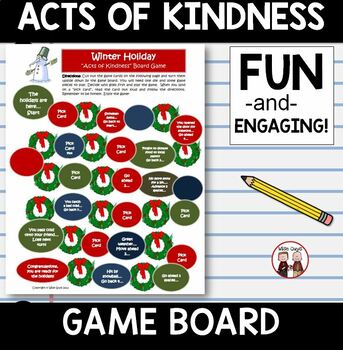
This is a game with a "Acts of Kindness" and winter theme. All you need as a teacher is to print the game board (cardstock seems to work best), cut up the game cards, supply a die and some tokens for each team, and then watch the fun!
Examples of game cards are:Have you ever donated food to the needy? If you have, go ahead 5 spaces. If not, stay where you are. Did you give someone a hug in the last 24 hours? If you have, go ahead 3 spaces. If not, stay where you are.
This is a fun activity that could maybe be used as a station during a holiday party or other classroom activity. You can download it by clicking here!
Here is another freebie! Teacher Christmas Gift for Students.
Instead of buying a gift we offer our students a FREE book choice from Scholastic Book Orders. Students are allowed to pick out a free book up to a certain price range. Then, we place the order and have the books before they leave for vacation!
Download this FREE resource by clicking here.
Finally, a third freebie is our Christmas Student Book Exchange.
Included are: teacher directions on how to do the book exchange, a family letter to send home, and a student sheet to fill out the books that each child wants. No more meaningless presents. Students enjoy this!
Download this FREE resource by clicking here.
Make sure to follow us on TPT for more great 3-5 resources!
Saturday, October 31, 2015
Vocabulary Card Games
Every
subject in school has academic vocabulary that students are going to need to
learn, so why not make it fun? In this
post I’ll show you 3 common games I’ve adapted to making learning new
vocabulary engaging for almost any subject area or grade level.
To
start with, when you teach a new unit of study there is usually a set of
academic vocabulary that goes along with it that students need to know to help
them understand the content. When you’re
planning a unit, make a list of the most important vocabulary words along with
their definitions, sentences, and a picture if possible, to help students
understand the word. This is especially
helpful for ELL students.
Once
you have your list made, write all your vocabulary words on a set of index
cards with the word (and picture if you can) on one side and the definition on
the other. Once you do this you’ll be
ready to play any of these games.
In
my class I made all of my vocabulary cards look like tradingcards to
increase the engagement with my students.
I’ve made these trading cards for over 80 topics and you can check them
out in my TPTstore.
![]() |
This
is a Kagan
cooperative learning game that many teachers use with task cards and it works
perfectly for sets of vocabulary words with definitions. The object of the game is for students to
quiz each other by giving the definition of the word or using it correctly in a
sentence. Here’s how to play:
|
1.Give
each student a vocabulary card.
2.Have
your students pair up.
3.Partner
A tells Partner B the vocabulary word on the card. Partner B tells Partner A the definition or
uses the word in a sentence (or admits they don’t know it). Partner A then acknowledges the correct
definition or gives it if needed.
Partner A can also give Partner B a clue if needed by showing them the
picture on the front of their card.
4.Partners
then switch roles with Partner B sharing their vocabulary word.
5.After
both partners have had a turn, they switch cards, find a new partner and play
again.
This
game will especially appeal to your visual learners! Here’s how to play:
•Split
your students into 2 (or more) teams and place a set of the vocabulary
cards face
down in the front of the room.
•Have
a student from Team A come up to the white board (or SMART board), take a card
from the bottom of the deck and read it silently, and try drawing it.
•Students
from
both teams guess the vocabulary word being drawn and whichever team guesses
correctly first gets a point.
•Then
a player from Team B comes up and the process starts over.
•Whichever
team has the most points when all of the cards have been used wins.
This
game will especially appeal to your kinesthetic learners! Follow the same steps as above for the
Drawing Game but instead of having students draw the picture on the card have
them act it out while teams guess what word they are acting!
It
takes a bit of time to make a set of vocabulary cards for a subject, but once
they’re made you can use them for these games year after year. If you’d like to save yourself some time
check out the trading cards in my
TPTstore. I’ve already gone through the trouble of
picking out the key vocabulary for almost 80 different topics, and finding
pictures, definitions, sentences, and more to go with them. The trading cards come in sheets of 8 that
just need to be printed out, cut up and they’re ready to go.
I
hope you enjoy using these games in your classroom. If you want to find out more ways to use
trading cards in your classroom check out my site TeachingWithTradingCards.com. You can also connect with me on my blog
at MrElementary.com .
Sunday, October 18, 2015
One Simple Way to Teach Critical Thinking + a Freebie!
Hi Everyone! Kelsea here from Teacher Gems! Today I will be sharing one simple strategy for increasing your students' higher-order thinking skills.
Have
you ever felt bogged down by the need to cover so many standards or to get through a
particular curriculum? With so much expected of teachers to cover these days, this can
become a reality for many! Unfortunately this can also lead our students to
believe that their main role is to get the work done quickly and correctly. If
they can come up with the correct answer quickly there is no need to think
deeply or critically about what they are learning.
Ideally
it would be wonderful to incorporate critical thinking skills into each of our
daily lessons but this is not always realistic. There are however several ways
we can be purposeful about teaching critical thinking. I want to share one of those methods with you today. It is a method that I
have found great success with my 4th grade students. It is a simple, fun way to teach
critical thinking AND it can be a spare time activity and not take away any of
your precious teaching time. Logic puzzles!
Logic
puzzles are so much fun for students and can really help develop critical
thinking skills! In my classroom I set up a tub specific for logic puzzles in my
math center. I
included several copies of each puzzle so there were enough for each student to
complete at their own pace. I found that most students are self-motivated by
the puzzles but a few will give up after trying
one or two if they think they are too hard. To solve this problem I created a
logic puzzle incentive program where students are rewarded for doing puzzles.
When
introducing logic puzzles it is important that you teach your students how to
solve them first. I prefer to use the grid style logic puzzles because they
provide students with a scaffold to use for process of elimination. To get you started here is a free sample from my Fall Logic Puzzles. I hope your
students enjoy!
Thanks for stopping by!
Tuesday, September 15, 2015
The Simple Way to Help Students Create Their Own Writing
Provide students with word lists!
Yes, supply your students with words to help them brainstorm. Of course you can brainstorm as a class, but if you are crunched for time, give it to them and let them get writing! Or use a list already created to help brainstorm even further. I know you are probably thinking, duh, everyone does this, but believe it or not, I've been in classes that it doesn't occur. As a young teacher, I used to think that if I gave them words, they weren't being creative. That is not the case! It simply gives them the boost they need to get the pencil moving! I have been pleasantly surprised over and over again. Now, as a veteran teacher, I always supply them with WORD LISTS with writing assignments! This doesn't mean I allow them to copy my modeled examples or any other examples. NO WAY! It just means they now have the resources they need to be creative on their own. WORDS WORDS WORDS!
Everyone gets writers block!
Although my family says I can talk to a wall, I often get writers block too! No lie! A cute idea, is to give students WRITER'S BLOCK SIGNS while writing. If they need help, they can raise up their sign! Have you ever looked around the room and saw everyone's hand up? Don't let panic mode set in, make it a learning experience. I might go over to a student's seat and say things like, "Hey class, I am searching for a word that rhymes with ring." Many suggestions are called out. Or, "Hey class, look around the room. If you see someone with a sign up, help them find a word they need, ready go!" I don't let it last long. Just a quick way to get some more words "Unblocked." Classmates are always willing to help!
Signs
These cute little signs come in 4-packs at Michaels. Use chalk to write different messages on them. Place them at writing center or have one for each student during your writing time!
Writer's Block Soap?
I saw this in Whiskey River Soap Co. and was cracking up so I had to post!
Monthly Word Lists
I realize there are word lists for everything, but I started Monthly Word Lists that especially help when writing poetry. I like to teach at least one poem a month so the word lists come in handy! Click below for MONTHLY WORD LISTS! The first three months are free!
I hope this will help you remember to give your students word lists in the future! Enjoy the freebies!
Pam
Visit ROCKIN RESOURCES store! They offer a variety of free and paid products ranging from grades 2-6. Pam specializes in LANGUAGE ARTS and SOCIAL STUDIES. She is well-known for her BTS (BOOST TEST SCORES) WRITING PROGRAMS that have been best sellers and boost writing scores!
Thanks again Hilary for the opportunity to post on this amazing blog! The content on here is incredible and there are so many talented teachers offering their expertise!
Saturday, August 15, 2015
Mining for Spelling Patterns
Happy Saturday! I'm Pamela from Hedgehog Reader, and I am here to share a fun way that students can play with letters and words to discover, practice, and reinforce spelling patterns.
Have you ever played Word Mines? Maybe you've called them something else... Basically, here is how Word Mines go:
You are given a word (or sometimes a phrase). To play, you form as many words as possible in the given time using only the letters presented. (If there is one R, then R can be used only once in that word. It can be used once again in another word, and so on.)
Call me a nerd (believe me, you won't be the first!), but this has been one of my favorite pastimes for as long as I can remember. So it was a natural thing for me to develop Word Mines for my students, because I knew it would be a fun way to identify, discover, and play with spelling patterns!
How to Start:
Although it doesn't take long for students to learn Word Mining strategies and procedures, it does require at least one session of whole class instruction to ensure smooth sailing ahead:
- Students are ready for Word Mines when they have started to develop phonemic awareness, and have begun to identify common spelling patterns. They should also have some sight words under their belts.
- Make sure that any word you give students to "mine" is one that holds plenty of words within it. Not all words are suited to this activity, so my best advice is to try it yourself first.
- It's fun to use seasonal words or vocabulary pulled from content areas of current study.
- I find that controversy is avoided by declaring the following rules: *No proper nouns *No foreign words *No contractions
- I begin by projecting the word to be mined. (I've created cute seasonal Word Mines so that I could put them under the document camera, but you can also simply write it up on your board.) Although traditional Word Mines are done with a word or phrase in its original form, I always scramble mine so that students get the bonus activity of solving the "secret word."
- Depending on the age of your students, it's often helpful to begin with letter tiles, one for each letter in the scrambled word. This allows students to physically manipulate the letters (concrete reasoning), until they are ready to move into mentally manipulating the letters (abstract reasoning). This also ensures that letters are only used as many times as they are found within the word.
- I model my thinking aloud as I "solve" the projected puzzle. I make sure to demonstrate how patterns can help. For instance, if I see the pattern ALE, I will play with each consonant and blend to see if it fits with the pattern to create a word. Then I move from ALE to EAL and repeat the process.
- Normally after one such session, students are ready to mine for words on their own, with a buddy, or in a team.
Use Word Mines as a Whole Class:
Once students have a grasp of how to work with Word Mines, these make a great Morning Work activity or sponge activity, either individually, in buddies, or as teams:
- Students stay even more focused if they know they will have 3 minutes for team consultation to tally up total words once the time is up. It only takes a moment or two to quickly go through how many words each team came up with (I am not picky, and the students do a wonderful job holding one another accountable for following the rules), and points are awarded for order of most words found. For instance - If you have 6 teams in your classroom, the team with the most words earns 6 points, and then work your way down to 1 point for the team with the fewest words - so everybody earns something!
Use Word Mines in a Literacy Center:
Word Mines make a great literacy center activity:
- Glue a puzzle to the front of a file folder or manilla envelope. Hide an answer key inside. Provide a set of laminated letter tiles.
- Students can record their answers on notebook paper or whiteboards, or on prepared worksheets.
- It’s best to use only one puzzle at a time to prevent confusion; puzzles can be changed out based on your students’ need.
I've created this FREEBIE for you to try out a Word Mine with your students! (I have various seasonal and thematic Word Mine resources in my Teachers Pay Teachers store, and I add to my collection often.)
Have a wonderful year with your students, and thanks for reading!
Sunday, June 28, 2015
Effective Ways to Teach Greek and Latin Roots AND Vocabulary
Next, add the words to a word wall in your classroom. This is extremely important so they can see it throughout the week! Whether they are getting in line, going to the restroom, or sharpening a pencil, they have that chance of seeing it! Below is an example of a Greek and Latin display I created in my classroom towards the beginning of last school year. Each unit is either Greek or Latin. I place the Greek words on the left and the Latin words on the right. I also mount them on different colors. Prefixes are placed in the clouds, root words are placed by the trunk of the tree and on the roots, and suffixes are placed below the roots. (I attempted to make a burrow of some sort.) No laughing please!
Ex. She placed her telescope on a _____________ to look at the stars in the sky. (tripod)
I also give them flashcards to use to study each night!!!
Day Two- Everyone gets out their homework. If someone comes in with simple sentences, (I use a ______.) I bring them back to my table and help them write good sentences while others exchange their papers and fill in the blanks. I also hold them accountable for the following week. Then we play a game. My favorite is Headbandz! I'm sure you've seen this game in stores. Use it with vocabulary words! It is the greatest and the kids have a blast! Below is a picture of my daughter and good friend as we play the real Headbandz at home. At school, I replace the game cards with our vocabulary cards. With this game, students give the person with the Headband on clues to their word until they guess it correctly. Here is a pic of a student when we played it for a Social Studies review! ( I love the student in the background.)
Shelly was having trouble sleeping. It has been a whole decade since she was able to saw wood! She tried many outrageous attempts to try to catch a wink. First, she participated in all ten events of a decathlon. The exhausting competition did not help her sleep so she rode her unicycle around the outside of the Pentagon in Washington, DC for 5 days. She decided to go home and get some cheese for a snack. She trisected the cheese so she could have it again for two more nights. When Shelly tucked herself in bed that night, her eyes remained wide open! Since she was still awake, she put her telescope onto a tripod and glanced up at the pentacle in the night sky. The room was so quiet that she heard crickets singing in a hexameter verse. They were all in unison too! What finally put Shelly to sleep? She started counting sheep on her hexagon-shaped ceiling. Why didn't she think of that earlier? She was now snoring. Zzzzzzzzzzzz!
For Homework: Draw a picture depicting each word. I have my students write the answers on a separate piece of paper so we can exchange them the next day in class! Also study flashcards.
Day 4- Students exchange their pictures and guess the correct word from homework. Then we play the game I Have Who Has. These are easy to make for your word list.
Homework: I like to incorporate some sort of technology throughout the week. Since most of my students had computer access this past year, I had them either create a crossword puzzle in Puzzlemaker or one of my students will make a Quizlet for me to assign. (If you teach upper elementary, they are completely capable and willing to create it for you! I usually offer a coupon for my treasure chest for those who offer to make one. Sometimes I have too many people who want to do it and I have to assign it to someone!) They love to compete against each other on Quizlet to see who can get the best time. If a student doesn't have internet access, I tell them to create flashcards to play Concentration. (Their flashcards from Day 1 won't work because they are printed on front and back.
Day 5- Before the quiz, we have one last review. I might have students act out a word or even have them create a jingle with some or all of the words for first work and share it before the quiz. Quiz- This also includes a spiraling review. I include 5 questions at the end of each test where students have to remember past words studied in class. For each word list of the year, students get a hard copy and add them to a metal ring. That way they have all the words to study for the spiraling review. You will be surprised at how much they retain by the end of the year!
If you would like a free unit of Greek and Latin prefixes, click on the picture below!
Visit ROCKIN RESOURCES store! They offer a variety of free and paid products ranging from grades 2-6. Pam specializes in LANGUAGE ARTS and SOCIAL STUDIES. She is well-known for her BTS (BOOST TEST SCORES) WRITING PROGRAMS that have been best sellers and boost writing scores!
Thanks again Hilary for the opportunity to post on this amazing blog! The content on here is incredible and there are so many talented teachers offering their expertise!
Subscribe to:
Posts (Atom)