Pages

Showing posts with label Brittany Lynch. Show all posts
Monday, March 7, 2016

Acting Out Positional Words {FREEBIE}

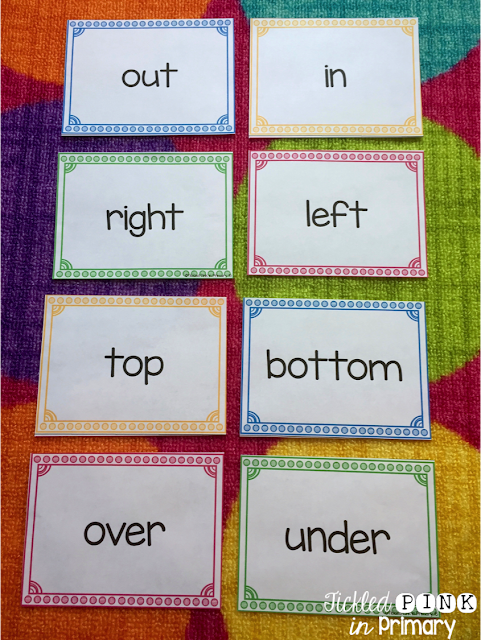
Positional words are a fairly easy concept for students to understand. Even thought it's a math concept, it can help them expand their vocabulary and use better describing words in their writing too. In the past, I've taught positional words with a student holding a teddy bear counter and having to move it around their body depending on the word I said. I decided to make it a bit more interactive and let the kids work together in pairs and act out their positional word to the class. 
 Students were allowed to use anything in the room as a prop to act out their word.
They thought it was really fun that they were allowed to even stand on the chair and tables if needed!
They had a lot of fun with this activity, so I figured I'd whip up a cuter set of flashcards as a FREEBIE for you! 
You can grab these FREE flashcards in my TPT store! 


Monday, January 4, 2016

Helping Students Transition Back from Winter Break

You haven't had school in over 2 weeks so you've probably enjoyed binge watching tv, staying in your pajamas all day, and eating whatever/whenever you want (please tell me that's not just me). Getting back in the swing of school is going to be hard for you and your students, but here are a few tips to help make that transition a bit easier. 

1. Review the Rules/Expectations
Just like the 1st day of school, going over the rules after break is essential! Now is a good time to review all of the classroom rules and decide if you need any more in place. One year, I let my class come up with the rules. I know you probably think that's crazy! Well, check out this huge list they came up with. I even had to cut them off! By allowing them to create the rules, they take ownership of them. However you do your rules (student led, classroom, school wide, etc), make sure to go over them and make sure students remember the consequences of breaking the rules. 
 I personally think #10 is the BEST!!
 2. Review Procedures
Along the lines of reviewing the rules, discussing the classroom procedures is also vital. Discussing arrival/dismissal procedures, classroom jobs, bathroom/drink privileges, lunch procedures, fire/tornado drills, center time, etc. are all important things to go over. We can't assume that students will remember EVERYTHING from before break. All the hot chocolate and candy canes fog up their head for a bit. :)
3. Give Students a Break
You know how exhausted you are the first week after a break and you just can't wait for lunch, recess, and your prep so you can just sit and catch your breath, well your students are like that too. So ease them back into the long daily routine. Throw in some brain breaks like these quick cards you can put on a ring for quick access.
These Fluency & Fitness Slideshows are fun because they review skills and get in movement. 
4. Take Time to Review Old Skills
We cannot expect our students to just get back in the swing of things and start learning a new topic. Your first week back is a great time to do a quick review on the main skills you've taught already this school year. Students are going to need time to practice the skills and strategies they haven't used for the past few weeks. Winter break isn't as bad as when students come back from Summer vacation, but a refresher course is a good way to transition back into the first week. It will also save some of your sanity of planning over break, because you can just pull out old lessons and activities for this review week. 
5. Let Students Share About Their Break
Students have so much they want to share about with you and their friends when they get back to school. It's been about 2 weeks without their friends, so you know they're going to want to talk. When they arrive in the morning you can use these FREE Winter writing prompts to have students write about their break. Then you can gather around in a circle and let each student have a few minutes to share about their break. 
Hopefully your first week back after break will go smooth. It's always fun to see your students again, but don't be surprised if you get this look a few times. :)


Tuesday, September 22, 2015

Comprehension for Beginning Readers

Teaching students to comprehend during/after reading doesn't always have to be a quiz or written responses. The idea of comprehension is simply to process what they are reading and understand it. Even the earliest of readers can start to show comprehension skills, even it's just with drawings. The importance of teaching comprehension is so students understand what they just read, and they aren't just reading word without putting meaning behind them. 

Even at the beginning of Kindergarten, we start working on comprehension skills. For my higher academic students, we use this Decode & Draw worksheet bundle which have students read the simple word and then draw a picture to match. My goal is to see if students are able to know what that word means they just read. These worksheets are differentiated with 2 versions: words or simple sentences. 
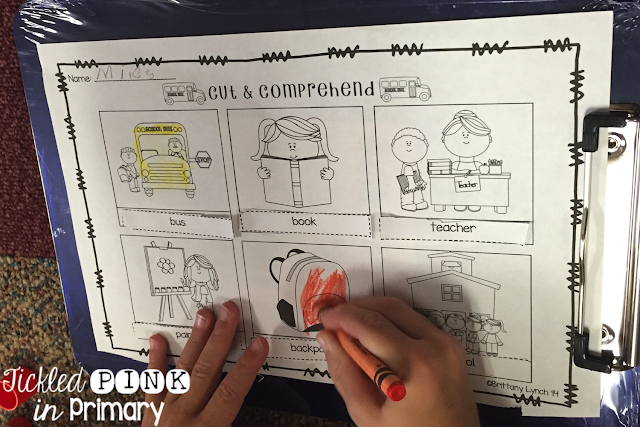
These Cut & Comprehend worksheets are similar and differentiated as well, but students have to cut & paste the words to match the picture.  I told the students that if they couldn't read the word, then they could look at the beginning sound to give them a clue. I made both of these bundles with 2 versions for every month of the year. I can throw these in centers and students will know what to do with this activity all year long! 
Really Good Stuff sells these beach balls that are a fun way to work on comprehension after a read aloud. Throw the ball to a student, have them pick a question and respond to the answer. It's a fun way to engage students, as well as see who was not only listening to your read aloud, but also was processing what you were reading.
Once we start getting our book baskets and attempting to do picture walks and read words, I use these Interactive Reading Responses. Since not all students are on the same level, I can differentiate the pages each students gets and whether they draw or write out their answers. I worked with this student 1 on 1 to discuss the book "Chicka Chicka Boom Boom". He understood the idea of sequencing, but isn't quite ready to write sentences or words yet. I told him he could illustrate what happened in the book and tell me about it when he was finished. Can you tell the letters are falling out of the bent tree...so cute!
The story starter pages in this bundle come with dotted lines and regular lines, depending on what your students need. In the past at my listening center, students would just write and draw about their favorite part. These responses get the students to think more about the book and find ways to connect to what they read. 
 
Here are a few more examples of the interactive pages. Having these fun response sheets available will make your students pay more attention to these skills during their story.
There are over over 20 pages of reading responses to help your students work on comprehending what they read. You can find this bundle in my TPT store here


Monday, July 13, 2015

FREE Activities to Work on Learning Names

Learning how to write your name is such a big deal when you're little. Many of us still have Kindergarten students coming to school that still don't know how to write their name or write it correctly. It drives me nuts when students come to me writing their name in all capital letters. Who teaches them how to write that like?? I know uppercase letters are easier to form, but that's not how to correctly write a name. I've even had students argue with me and tell me that's not their name when I show them what it should look like. Here are some activities I use to work on recognizing our names, writing our names, and learning our friend's names too. 

To incorporate fine motor skills and name practice, I use toothpicks. Each student gets a paper with their name on it. They then take a toothpick and poke holes through their name. This could be used for sight words, letters, numbers, etc. throughout the whole school year because the students have so much fun with it. 
Once they are done with their name, they can hold it up to the light and it kind of making it looks like their name is shining like stars.  
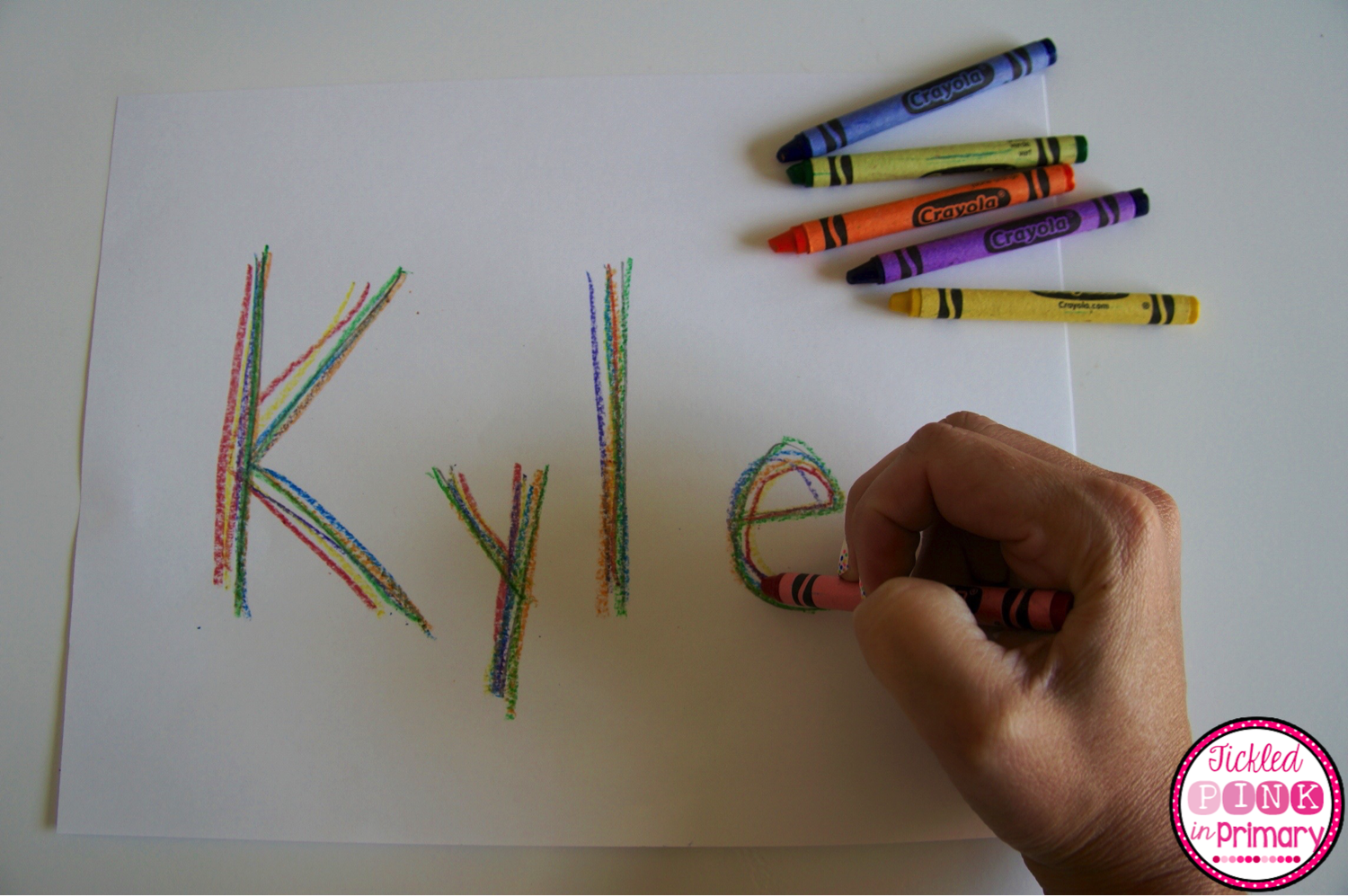
Rainbow writing is such a easy way to practice names. I write their name on a piece of paper and they take turns using different colors of crayons to trace their name. Super simple, yet fun!
I teach students "The Plate Song," to learn their name, but also start to recognize their friend's names. We form a circle on the rug, then sing "The Plate Song" and I throw 2-3 plates on the ground. If a student recognizes his/her name, they get to pick up the plate. So simple, but they love it! The song is very catchy too, so after 2 times of singing by myself, most of the kids have already learned it. 

The Plate Song
tune: If You're Happy And You Know It

If your name is on a plate pick it up, (clap clap)
if your name is on a plate pick it up, (clap clap)
if your name is on a plate, then you're doing really great,
if your name is on a plate pick it up!
Lastly, I incorporate sorting into our name unit. This way I can work on names during reading, writing, and math! I created this FREEBIE for you to use your first few weeks of school. It has many activities included to help students recognize their name, as well as their peer's names. Students can work on counting letters, clapping syllables, and sorting! I write student names on flashcards and use pictures of each student for different sorting activities. At the beginning of the year, you may just have students play memory with their friend's pictures, but later in the school year, they could match the picture to a name. These activities could easily be put in a center tub or pocket chart. 
Click here to grab these activities for FREE!


Tuesday, April 21, 2015

Tackling Tricky Sounds ~ Silent e & Bossy R

I introduce r-controlled vowels as "Bossy R" because the R always bosses the vowels around. In Kindergarten, this idea is much more fun than calling them r-controlled vowels. :) I found this video on YouTube by Preschool Prep Company called Controlling R Song. It's has a catchy tune for the kids to pick up on and remember what the job of Bossy R is. I use this video when introducing this concept. 

Since this is a difficult skill, especially in Kindergarten, I decided to make up my own Bossy R Bundle full of games. I used these cards in my pocket chart when working as a whole group on Bossy R.  I passed out the word cards, students had to read them, and come up and match it to the picture in the pocket chart. Now they can play this game independently at centers or they can turn it into a memory game. 
To see if my students are actually reading Bossy R words, I made up this worksheet so they have to draw the picture after they read the word. I have a lot of kids that love to draw, so this way I can incorporate that into their literacy time. 
I put this game in centers for students to practice reading the Bossy R word or saying what Bossy R sound they hear in the picture. They can then roll the dice and move around the game board. 
To work on filling in the correct sound, students would use these popsicle sticks and place the correct sound in the middle of the word. I put the answer on the back, so these can be self-checking. 
When introducing silent e (as I call it), I tell them that silent e has to remain quiet, gets mad that he can't talk, so he pinches the vowel and makes it say its name. I found this Silent e Song on YouTube also by Preschool Prep Company. It's another fun way to teach students that the e at the end of the word, makes the vowel say it's name.
I also made a Silent e Bundle to use in our literacy centers as well. Many of the games are very similar to the Bossy R Bundle, so students will already know the game format. For the game below, students have to read the word before they can roll the dice and move around the game board. 
We used these cards in our pocket chart as a whole group, just as we did for Bossy R. Now they are in centers as well.
My students have a lot of fun using these pointers to turn CVC words into CVCe words. 
To get some more practice with Silent e and Bossy R, I use Starfall's "Learn to Read" page that has games for both skills! These games have students fill in the missing sounds to spell the word that matches the picture shown. 
You can grab the Bossy R and Silent e Bundles in my TPT store by clicking the pictures below!